
How an Employee Recognition Points Program Works
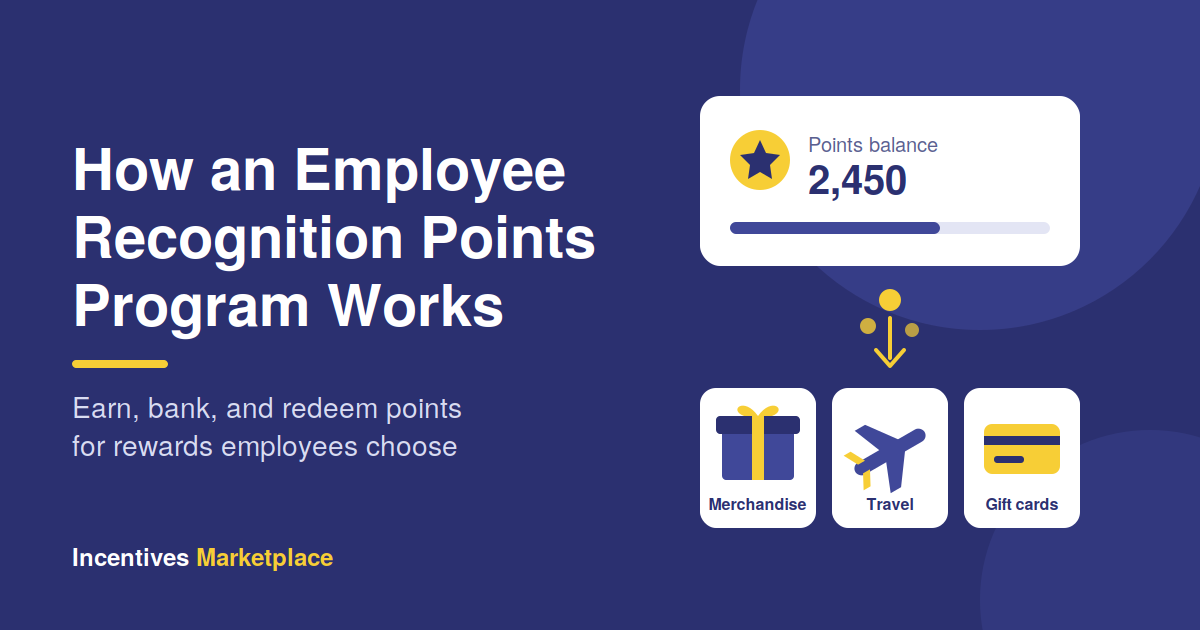
An employee recognition points program lets managers and peers award points for specific behaviors and milestones. Employees bank those points and redeem them for rewards they choose from a catalog. Points make recognition frequent, trackable, and easy to budget, while the breadth of the reward catalog largely determines whether employees keep participating after launch.
What Is an Employee Recognition Points Program?
An employee recognition points program is a structured system in which employees earn points for defined achievements, behaviors, or milestones and redeem them for rewards. Points act as a common currency: a manager in one department and a peer in another can both recognize the same employee, and every award adds to one balance.
Two features separate a points program from an employee-of-the-month plaque or an occasional bonus:
- Consistency. Earning rules are written down and tied to company values, so recognition does not depend on any one manager’s habits.
- Choice. Employees decide what their points become, whether that is merchandise, a gift card, an experience, or a larger reward they save toward.
A points program is one format within a broader employee recognition strategy, and it often runs alongside milestone awards and manager recognition.
How Does a Points-Based Recognition Program Work?
Most points-based recognition programs follow the same six-step cycle:
- Set earning criteria. The organization defines which behaviors and milestones earn points and how many.
- Fund point budgets. Managers, and often every employee, receive a point allowance to give.
- Award points. Managers and peers send points with a short message explaining what the person did. Some awards, such as service anniversaries, trigger automatically.
- Accumulate. Points collect in each employee’s balance, where they can be spent right away or saved.
- Redeem. Employees exchange points for rewards in a catalog.
- Report. Administrators review who is giving and receiving recognition, for what, and at what cost.
How Are Recognition Points Budgeted?
Organizations usually combine more than one funding model:
| Model | How it works | Best for |
|---|---|---|
| Monthly manager allowance | Each manager receives a fixed number of points per month to award | Creating a steady, predictable recognition cadence |
| Annual manager pool | Managers receive a yearly budget and decide when to use it | Teams with seasonal or project-based peaks |
| Peer giving allowance | Every employee receives a small monthly amount to award colleagues | Spreading recognition beyond the management chain |
| Automated awards | Points are issued automatically for set events, such as service anniversaries | Milestones that should never be missed |
Monthly allowances tend to keep recognition regular, because managers who have not used their points are prompted to look for moments worth recognizing instead of saving everything for year-end.
How Much Is a Recognition Point Worth?
There is no universal standard. Each organization sets its own conversion rate. Larimer County, Colorado’s employee recognition program, for example, values 10 points at $1 (Larimer County). Whatever rate you choose, publish it so employees always know what their balance is worth, and keep it simple enough that finance can model the annual cost per employee.
What Should Employees Earn Points For?
The most effective programs map earning criteria directly to company values and strategic priorities. Common categories include:
- Service anniversaries and milestones that show tenure is valued, not just recent output.
- Safety achievements such as completing required certifications, reporting near-misses, or reaching an incident-free period.
- Collaboration and peer support, including mentoring a new hire or stepping in during a staffing gap.
- Customer impact, such as positive customer feedback or resolving a difficult issue.
- Skills and development, including finishing training or earning a professional certification.
- Values in action, for any behavior that clearly demonstrates a named company value.
Keep the list short enough that employees can remember it. Five or six clear categories are easier to use than twenty narrow ones.
Why the Reward Catalog Makes or Breaks the Program
Points only motivate if they turn into something employees want. When a catalog is thin or generic, balances sit unused and the program loses credibility. When employees at different ages, life stages, and income levels can each find something meaningful, they keep earning.
A strong catalog usually mixes several reward types:
- Merchandise such as electronics, home goods, and outdoor gear
- Digital gift cards for flexibility and fast fulfillment
- Experiences, from event tickets to dining
- Travel for employees saving toward a larger reward, similar to the premium rewards used in travel incentive programs
- Branded and milestone awards for service anniversaries and major achievements
Points and gift cards are not interchangeable. Our comparison of points-based rewards and gift cards explains when each works best.
How Are Recognition Rewards Taxed?
Reward type affects taxes. Under IRS Publication 15-B, the exclusion for employee achievement awards covers tangible personal property given for length of service or safety achievement, up to $1,600 per employee per year for qualified plan awards and $400 for nonqualified awards. The exclusion does not apply to cash, cash equivalents, gift cards, gift coupons, or gift certificates, except arrangements that only let the employee choose tangible property from a limited assortment the employer preselected (IRS, 2026).
| Reward type | General treatment |
|---|---|
| Cash or points converted to cash | Taxable wages |
| Gift cards and gift certificates | Taxable wages |
| Tangible merchandise for length of service or safety achievement | May be excludable up to IRS limits if all requirements are met |
| Tangible merchandise for other reasons, such as performance | Generally taxable |
Rules have additional conditions, so confirm your program’s treatment with a tax advisor before launch.
Why Do Points-Based Programs Boost Engagement?
Points programs work because they fix the most common recognition failure: it does not happen often enough or consistently enough.
- Recognition is scarce. Only one in three U.S. workers strongly agree they received recognition or praise for good work in the past seven days, and employees who do not feel adequately recognized are twice as likely to say they will quit in the next year (Gallup, 2016, updated 2024).
- Managers drive the outcome. Gallup estimates managers account for at least 70% of the variance in employee engagement scores across business units (Gallup, 2015). A points budget and clear criteria give every manager the same tool, which narrows the gap between teams with great recognition habits and teams without them.
- Engagement pays off. In Gallup’s 2020 meta-analysis, top-quartile engagement teams outperformed bottom-quartile teams by 18% in productivity (sales) and 23% in profitability (Gallup, 2020).
- Retention protects the budget. Replacing an employee can cost one-half to two times their annual salary, according to Gallup (Gallup, 2019). A recognition program that helps keep good people is a cost-control measure as much as a culture initiative.
Points also make recognition specific. A message attached to points explains exactly what was valued, which shows the whole team what good work looks like.
Best Practices for Designing and Launching a Points Program
- Tie criteria to values. Every earning category should map to a behavior the company is actively trying to reinforce.
- Include peers from day one. Programs limited to manager-to-employee recognition miss much of what happens day to day.
- Build a broad catalog. Offer enough variety that every employee can find something worth earning.
- Publish the rules. Explain earning criteria, point value, and any expiration policy before launch.
- Train and remind managers. Recognition is a habit. Short monthly reminders and usage reports keep allowances from going unused.
- Involve employees. Ask for input on catalog choices and earning categories. People engage more with programs they helped shape.
- Review quarterly. Track participation, redemption rates, unused balances, and cost per employee, then adjust.
For the wider program design, see our guide to structuring an employee recognition program.
Frequently Asked Questions About Employee Recognition Points
How much is an employee recognition point worth?
It depends on the program. Each organization sets its own conversion rate based on its budget and how it wants balances to feel. Some programs keep the math as simple as possible, while others use larger point numbers so balances feel more substantial. Larimer County, Colorado, for example, sets 10 points equal to $1. The most important rule is transparency: employees should always know what their points are worth.
Are employee recognition points taxable?
Often, yes. Points redeemed for cash, gift cards, or gift certificates are generally treated as taxable wages under IRS rules. Tangible merchandise given for length of service or safety achievement may be excluded up to IRS limits when specific requirements are met. Because the rules have several conditions, confirm your program’s tax treatment with a qualified tax advisor.
Should recognition points expire?
It is a policy choice. Expiration encourages employees to redeem and enjoy rewards, and it limits outstanding liability on the books. On the other hand, strict expiration can frustrate employees saving for a larger reward. Many programs compromise with a long expiration window and reminders before points lapse. Whatever you choose, state it clearly at launch.
How is a points program different from a cash bonus?
A cash bonus is usually occasional, tied to a single result, and absorbed into regular pay. A points program recognizes many smaller contributions throughout the year, includes peers, and turns recognition into a reward the employee chooses and remembers. Many organizations use both: bonuses for major results and points for everyday recognition.
What rewards should a recognition catalog include?
Include a mix of merchandise, digital gift cards, experiences, and higher-value rewards such as travel that employees can save toward. Add branded milestone awards for service anniversaries. The goal is choice: employees at different life stages value different things, and a broad catalog keeps balances moving instead of sitting unused.
Design a Points Program Your Employees Will Use
A points-based recognition program works when the rules are clear, managers and peers use it consistently, and the catalog offers rewards people genuinely want. Incentives Marketplace builds employee recognition programs with reward catalogs that include merchandise, travel experiences, and digital gift cards. Schedule a demo to see how a points program could fit your organization.