Franchise and reseller networks run on motivation, but the way most brands try to maintain that motivation quietly destroys the margins they work to protect. The default lever is discounting: drop the price, spike the volume, and repeat. This is a trap. It feels like momentum, but it trains your partners to wait for the next promotion rather than sell on value, and it conditions your end customers to expect a price that was never sustainable in the first place.
The more durable path is a structured incentive program that rewards the behaviors you want, such as certifications completed, new accounts opened, brand standards upheld, and seasonal lines pushed, without touching your price architecture. This is not a theoretical substitute: franchise networks across food service, healthcare, and specialty retail have used behavioral incentive frameworks to drive partner performance while holding their margin floors intact.
The Margin Trap: Why Discounting Resellers Backfires
Most franchise executives understand, intellectually, that discounting is a short-term fix with long-term consequences. The problem is that the short-term relief is immediate and measurable: a price reduction produces a visible sales bump, while the long-term damage accumulates quietly across quarters. By the time the erosion becomes obvious, the discount expectation is already baked into your partners’ planning cycles. Recovery is difficult.
When you rely on discounts, the negative effects compound quickly:
Brand value erosion: Continuous discounting signals to both partners and end customers that your standard price is aspirational rather than real. Once that perception takes hold, it is extraordinarily difficult to reverse without losing volume.
Channel conflict: When resellers compete primarily on price, they inevitably undercut each other to close deals. The resulting tension, including margin disputes, territory complaints, and partner churn, costs far more to manage than any promotional discount saves.
Cash flow exposure: Upfront price reductions hit your margin at the point of sale, before you have confirmed whether the partner drove incremental volume or simply pulled forward demand that would have materialized anyway.
Expectation lock-in: This turns your promotional calendar into a purchasing calendar for your partners. They delay orders, defer commitments, and stall pipeline activity until the next discount window opens.
The structural problem with discounting is that it rewards the transaction rather than the relationship. A partner who buys more because you dropped the price has not become more committed to your brand; they have become more sensitive to your price. Behavioral incentive programs invert that dynamic by tying rewards to actions that build long-term capability and loyalty rather than short-term volume spikes.
Breaking the discounting cycle requires replacing a simple, reactive mechanism, price reduction, with a structured framework that rewards specific, verifiable partner behaviors. The design of that framework matters greatly, because a poorly constructed bonus structure creates its own problems: partners game the metrics, rewards feel arbitrary, and the program loses credibility within a few quarters.
The most effective franchise performance bonus structures share a few design principles. Keep them simple. Rewards are tied to behaviors the brand can verify independently. Thresholds are set at levels that require genuine effort but remain achievable for a motivated partner. And the program communicates clearly enough that a franchisee can explain their own earning potential without consulting a manual.
Tier-based incentive programs for franchisees: Progressive performance tiers, where rewards increase as partners hit certification milestones, quarterly growth targets, or operational compliance benchmarks, create a visible ladder that motivates sustained engagement rather than one-time bursts.
Retroactive rebates over upfront discounts: Rewarding partners with rebates after they have hit verified volume thresholds protects your upfront margin and cash flow. The partner still earns meaningful value; you shift the timing to a point where the incremental revenue is confirmed.
SPIFs for strategic alignment: Short-term Sales Promotion Incentive Funds are highly effective for driving specific, time-bounded behaviors, such as launching a new product line, clearing seasonal inventory, or activating dormant accounts, without permanently altering your baseline pricing. A well-designed SPIF campaign can move the needle on a specific objective in four to six weeks while leaving your standard price architecture untouched.
Co-op marketing fund alignment: Tying marketing development funds directly to performance metrics ensures that your highest-performing partners receive the most corporate support for local lead generation, while partners who have not met baseline engagement thresholds do not receive funds they are unlikely to deploy effectively.
The International Franchise Association (IFA) provides guidance on structuring compliant incentive frameworks within franchise agreements, which is worth reviewing before finalizing any program that touches royalty structures or fee arrangements, particularly for multi-unit operators where the financial implications scale quickly.
Explore our specialized channel incentive programs and B2B loyalty programs to see how we help franchise networks reward repeat engagement and drive profitable growth. For a step-by-step planning resource, our guide on distributor incentive programs walks through how to align your network without undercutting your margins.
The Power of Non-Cash Rewards for Channel Partners
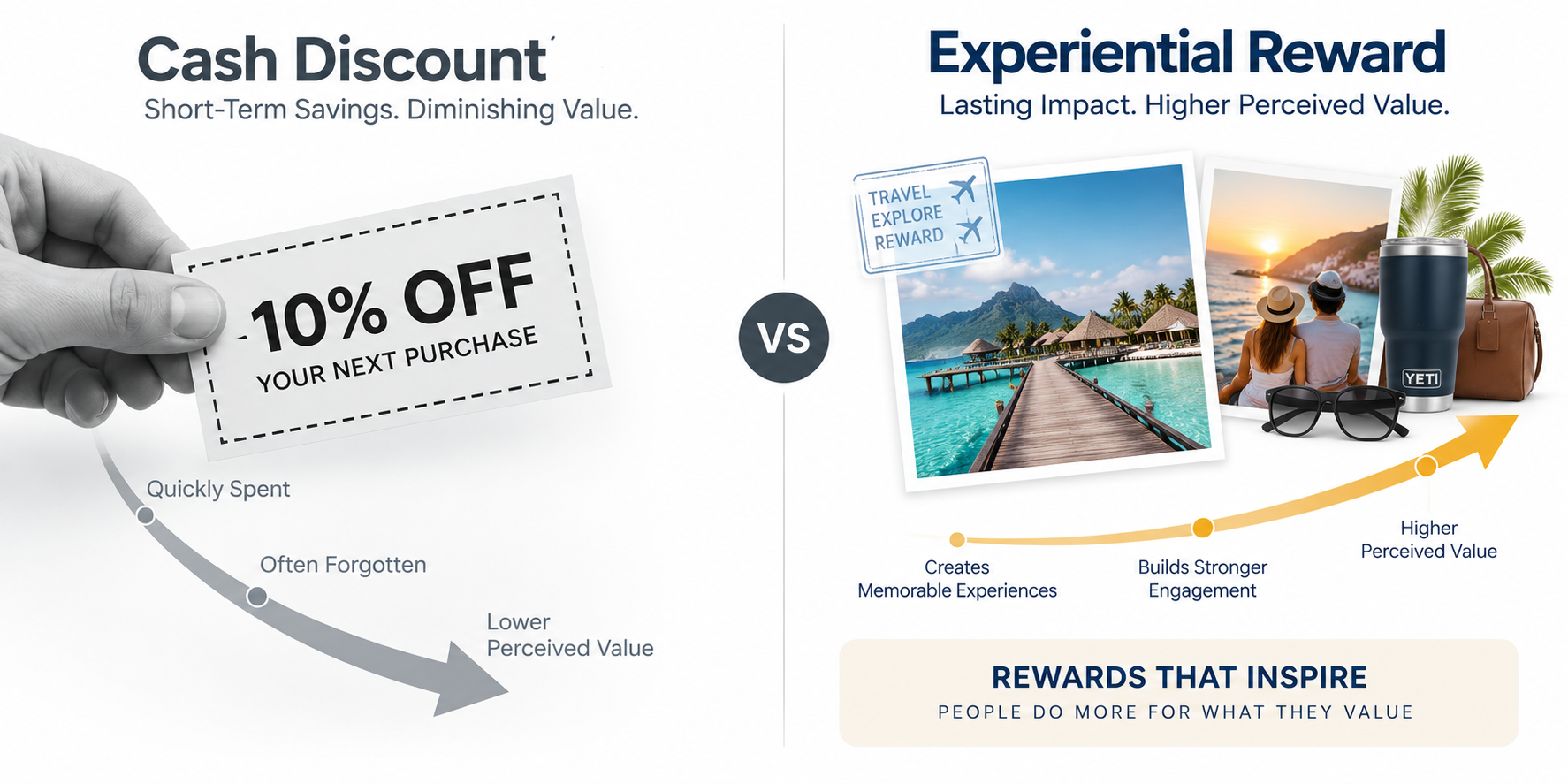
Cash discounts have a fundamental perceptual problem: they are taken immediately into operating expenses and forgotten. A franchisee who receives a retroactive cash rebate will likely apply it to accounts payable within the week. There is no lasting association with your brand, no story to tell at the next regional conference, and no emotional residue that makes them more committed to your network. The transaction closes, and the motivation resets to zero. Nothing changes.
Non-cash rewards operate differently because they create experiences and objects that partners associate with their own achievement. An incentive trip to a destination a top-performing franchisee would not have booked for themselves becomes a story they tell for years. A premium merchandise catalog that lets partners redeem points for high-end tech or lifestyle goods creates a tangible, visible symbol of their performance. These are not soft benefits: they are motivational frameworks that sustain engagement between reward events.
Research published by the Incentive Federation Inc., an authoritative body on corporate and channel incentive programs, consistently points to non-cash rewards as more effective at driving intrinsic motivation than cash equivalents. The underlying mechanism is simple. Cash is interchangeable and disappears into the budget, while a non-cash reward carries a specific identity that partners mentally label as earned recognition rather than compensation.
Experiential rewards and travel: Top-performing franchise owners respond strongly to exclusive incentive trips or curated experiences, particularly those that feel genuinely out of reach without the achievement attached to them. The exclusivity is part of the motivational signal.
High-end merchandise and tech: Curated redemption catalogs give partners agency over their rewards while keeping the brand association intact. Points earned through operational excellence become premium goods that reinforce the connection between performance and recognition.
Status and recognition tiers: Public acknowledgment at annual franchise conferences, featured placement in partner portals, or a named tier designation like President’s Club or Diamond Partner uses peer prestige in ways that cash simply cannot replicate.
Professional development and training: Access to exclusive business coaching, advanced operational training, or industry certifications rewards high-performing partners with something that directly improves their local business outcomes, which, in turn, improves yours.
Protecting Profit Margins Through Enablement-Focused Incentives
The most lasting margin protection strategy isn’t a reward program: it’s a partner capability progr
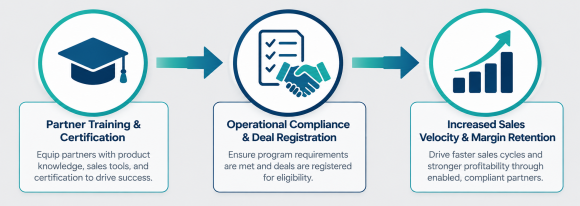
am that happens to include rewards. Focus on capability. When franchisees and resellers are genuinely equipped to sell your unique value without leaning on price, the discount conversation becomes less necessary. Enablement-focused incentives accelerate that capability development by attaching tangible rewards to the training, compliance, and deal-registration behaviors that make partners more effective.
This approach also addresses a structural inefficiency that most franchise networks carry quietly: a significant portion of the partner base is underperforming not because they lack motivation, but because they lack the tools, training, or operational clarity to perform at a higher level. Rewarding the act of closing that gap, such as completing a certification module, registering a new deal in the CRM, or passing a brand standards audit, creates a measurable pathway from current performance to target performance, with rewards serving as both incentive and acknowledgment.
Modeling the financial viability of an enablement-focused program requires careful budget planning before launch. Use our guide to calculate an incentive program budget to design a self-funding reward structure that aligns with your corporate financial goals and accounts for the incremental revenue generated by a more capable partner network. Our programs are easy to set up and simple to manage, helping you create a culture of motivation while simplifying the process.
Rewarding training and certification completion: Points or rewards tied to product training modules ensure that franchisee staff can explain your value confidently. This reduces the frequency of price objections at the local level and protects your brand positioning in markets where you have limited direct visibility.
Deal registration incentives: A structured deal registration program rewards partners for surfacing new opportunities early. This protects their local margins, prevents internal channel conflict between overlapping territories, and gives your corporate team visibility into pipeline health before deals are at risk.
Operational compliance bonuses: Franchisees who consistently meet or exceed brand standards, pass operational audits, and hit customer service benchmarks represent your brand at its best. Rewarding that consistency, rather than only rewarding revenue, signals that operational excellence is a corporate priority, not just a contractual obligation.
Best Practices for Reseller Motivation and Program Design
A well-designed incentive program can fail entirely if the execution is poor. Execution is everything. Franchise networks that have invested in sophisticated reward structures often find that partner engagement drops not because the rewards are unattractive, but because the rules are opaque, the fulfillment is slow, or the communication is inconsistent. The mechanics of delivery matter as much as the mechanics of design.
Simplicity in the earning rules is non-negotiable. Partners who can’t explain how to earn their next reward tier in two sentences will disengage within the first quarter. This doesn’t mean the program has to be shallow; it means the complexity should live in the backend logic, not in the partner-facing experience. A franchisee should be able to log into a portal, see their current points balance, understand exactly what actions will move them to the next tier, and redeem a reward without submitting a support ticket.
Automation is the operational backbone that makes this possible at scale. Manual tracking, spreadsheet-based point calculations, and delayed reward fulfillment are program killers, not because partners are impatient, but because delays create doubt about whether the program is real and whether the brand is invested in it. Platforms that deliver real-time point updates and automated reward fulfillment remove that doubt entirely.
Keep earning rules transparent and partner-facing: Every franchisee should be able to access a clear summary of the program structure, including tiers, thresholds, eligible behaviors, and reward options, without needing to contact a channel manager for clarification.
Automate fulfillment end-to-end: Real-time point crediting and automated reward delivery eliminate the administrative drag that erodes partner trust and internal program credibility.
Communicate progress consistently: Regular updates, such as weekly progress notifications, tier advancement alerts, and countdown messages as partners approach the next threshold, keep the program top-of-mind between major reward events.
Treat your incentive program as a collaborative investment rather than a corporate mandate. Partners who feel like the program was designed with their business needs in mind, rather than imposed on them from above, engage at meaningfully higher rates and sustain that engagement across program cycles.
Measuring the ROI of Incentive Programs
Treating an incentive program as an expense rather than an investment is the single fastest way to get it cut in the next budget cycle. The programs that survive, and get expanded, are the ones that generate a clear, justifiable return on investment measured against metrics that the finance team recognizes as meaningful. That requires deciding, before the program launches, which KPIs will define success and how they’ll be tracked.
The most useful program ROI metrics fall into two categories: partner behavior metrics and revenue impact metrics. On the behavior side, you want to track partner activation rate (the percentage of eligible partners who engage with the program), reward redemption rate, training completion rates, and deal registration volume. These metrics tell you whether the program is reaching the partner base and whether partners are taking the actions you designed it to drive. Low activation is almost always a communication problem; low redemption is almost always a rules complexity problem.
Revenue impact metrics are where the business case gets made. Numbers do not lie. Incremental revenue per activated partner, compared against a control group of non-participating partners or against the same partners’ pre-program performance, is the clearest signal of whether the program is generating returns above its cost. Tracking average order value, new account acquisition rates, and seasonal sell-through rates among program participants versus non-participants gives you the data to demonstrate that motivated partners genuinely outperform unmotivated ones, and by how much.
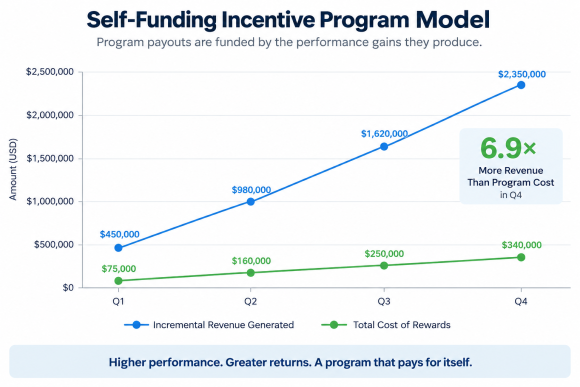
There’s a case to be made that the most important metric is program cost as a percentage of incremental revenue generated. A well-designed program should be largely self-funding: the additional margin captured from higher partner performance should cover the cost of the rewards, the platform, and the administration, with meaningful surplus left over. If that ratio is inverted. If you are spending more on rewards than the program is generating in incremental revenue, the issue is almost always in the threshold-setting or the behavior targeting, not in the reward value itself. Adjusting the qualifying behaviors and the tier thresholds is usually more effective than cutting the reward budget.
One metric that’s consistently overlooked is partner retention rate. The cost of losing a trained, certified, high-performing franchisee, and replacing them with someone who needs 12 to 18 months to reach equivalent productivity, far exceeds the annual cost of a well-funded incentive program. When you model program ROI, that retention value belongs in the calculation.
Frequently Asked Questions About Franchise Incentive Programs
What is the most profitable franchise to get into?
Profitability varies considerably by industry, but franchises in food service, healthcare, and specialized cleaning services tend to generate the highest returns on investment. The factors that drive long-term profitability, including brand recognition, operational support infrastructure, and manageable startup costs, matter more than the industry category itself. Regardless of sector, implementing structured franchise incentive programs is critical to helping local owners protect their operating margins by rewarding the behaviors that drive efficiency and revenue growth, rather than relying on price reductions that compress their already-tight unit economics.
What are examples of incentive programs?
Franchise incentive programs take several forms depending on the network’s goals. Common structures include reduced franchise fees for military veterans, multi-unit development discounts for operators who commit to expanding their footprint, performance-based royalty rebates that reward franchisees who hit quarterly growth targets, and financing assistance through third-party lender partnerships that lower the capital barrier for new operators. Beyond financial structures, brands use non-cash rewards, training completion incentives, and co-op marketing funds tied to performance metrics to drive specific operational behaviors across the network.
What franchise can I start with $10,000?
Few major franchises have a total startup cost at or near $10,000, but home-based service franchises, such as commercial cleaning, pet sitting, mobile notary, and consulting services, often have low overhead and franchise fees that fall within or near that range, provided you already own the necessary equipment. These low-overhead models depend heavily on local marketing execution and partner enablement to generate growth, which makes a well-designed incentive program particularly valuable for motivating franchisees who are operating without the brand visibility that a physical storefront provides.
What business has a 90% success rate?
No business category carries a guaranteed success rate, but established franchises consistently report higher survival rates than independent startups, largely because they enter the market with proven systems, established supply chains, and consumer demand that’s already been validated at scale. Industries like tax preparation, senior care, and fast-casual dining tend to show strong long-term survival rates for these reasons. Aligning those proven systems with effective channel partner incentive strategies, rewarding franchisees for operational excellence and customer retention rather than just revenue volume, further reinforces the structural advantages that make franchising more durable than independent business ownership.
Reach Out to Incentives Marketplace Today
Designing a franchise incentive program that rewards your network without eroding your margins is a strategic necessity for any franchise system that wants to grow sustainably. Moving away from transactional discounting toward behavioral, non-cash, and enablement-focused rewards protects your brand equity, builds genuine partner loyalty, and generates the kind of incremental performance data that makes the business case for continued investment. At Incentives Marketplace, we remove the guesswork from incentive planning. We help you turn appreciation into performance with flexible programs designed to align with your business goals.
Your goals. Our expertise. Results that matter.
Ready to transform your reseller network? Explore our franchise incentive programs to discover how you can drive performance, protect your margins, and achieve results that compound over time.
Most incentive program proposals falter before they reach a vote. Not because the program idea is weak, but because the document reads like a wish list rather than a business case. They want business cases. Executives and CFOs aren’t opposed to investing in people; they’re opposed to funding something they can’t measure, model, or connect to a strategic outcome.
A step-by-step framework helps you write an incentive program proposal that speaks the language of leadership, framing your program as a performance investment rather than a morale expense. You’ll also find a free customizable template to remove the guesswork from formatting and structure.
Why a Structured Incentive Proposal Is Critical for Executive Buy-In
The disconnect between a good incentive idea and an approved incentive program almost always comes down to how you position the proposal. Incentive planning can feel overwhelming, especially when you are caught between executive expectations and team realities. When a document leads with reward mechanics, such as the points system, the prize catalog, or the payout schedule, it signals to the finance team that this is a cost center. When it leads with business outcomes and ties every design decision back to a measurable organizational goal, it reads as a strategic initiative worth funding.
According to Harvard Business Review, human capital is increasingly viewed as a strategic growth enabler rather than a support function, requiring data-led workforce strategies and deliberate investments in people. That shift in perspective is exactly what a well-constructed proposal needs to reflect. The document you put in front of leadership should demonstrate that you understand the organization’s growth priorities and that your program is designed to accelerate them, rather than simply rewarding people for showing up.
The pressure this creates falls hardest on mid-level leaders. They carry the burden. They are the ones who understand what happens on the floor, in the field, or across the office, and they are also tasked with translating executive strategy into team behavior. A global survey of over 600 mid-level leaders found that 88% feel caught between the demands of senior executives and their teams, according to Harvard Business Review. That tension is real, and it’s one reason why a structured proposal matters so much: it gives mid-level leaders a credible, data-backed document to advocate for the resources and recognition their teams need. Well-designed employee incentive programs give those leaders both the autonomy to drive performance and the organizational backing to make it stick.
Defining Clear Objectives and Program Structure
Before you write a single section of the proposal, you need to know exactly what the program is trying to accomplish, and that answer has to be more specific than “improve performance” or “boost morale.” Executives will push back immediately on ambiguous objectives because they cannot be measured, and unmeasurable programs cannot be justified in a budget review.
Start with no more than three objectives, and make each one specific, measurable, and time-bound. “Increase regional sales revenue by 12% in Q3” is a proposal-worthy objective. “Motivate the sales team” is not. This level of precision also forces you to think carefully about program design from the start, because the reward structure, eligibility criteria, and payout triggers all flow directly from what you’re trying to move. Building an effective sales incentive plan means anchoring every design decision to those objectives so that the program’s mechanics and its business purpose are inseparable in the reader’s mind.
Once your objectives are locked, you need to define the reward structure your program will use. Think of your program structure like building a recognition system that fits your team like a custom suit: it needs to be tailored to the people wearing it. The three primary categories to consider are:
Monetary or Financial Incentives: bonuses, profit sharing, stock options, and commission accelerators that provide direct financial benefit tied to performance outcomes.
Non-Monetary or Experiential Incentives: travel rewards, employee gifts, extra time off, and experience-based recognition that carry high perceived value without always carrying a proportional cost.
Recognition and Autonomy: employee recognition programs, professional development opportunities, and increased decision-making authority that address intrinsic motivation and long-term engagement.
Most high-performing programs blend all three categories, because different roles and different people respond to different motivators. The mix you choose should reflect what you know about your target participants, not just what’s easiest to administer.
Ready to align your team’s performance with company goals? Talk to the experts at Incentives Marketplace to explore flexible programs that fit your goals.
Establishing Eligibility and Performance Criteria
Eligibility and performance criteria are where many proposals lose credibility. If the criteria feel arbitrary or the KPIs seem disconnected from actual business outcomes, the proposal signals that the program was designed around what is easy to measure rather than what matters most. Compensation systems that aren’t properly aligned with performance data can actively hold organizations back from executing growth strategies, which is a risk worth naming explicitly in your proposal to show leadership you’ve thought about the downside. Helping your people feel valued so they naturally do their best work is like tuning an engine: you want every part moving in harmony. When designing a sales incentive program or any performance-based initiative, the eligibility framework needs to connect directly to the roles and behaviors that drive the outcomes you’ve already defined in your objectives.
Setting realistic but genuinely challenging goals is one of the harder balancing problems in incentive design. Set the bar too low, and you’re paying out for performance that would have happened anyway. That wastes budget. Set it too high and participation drops, which undermines the behavioral change you’re trying to create. The most defensible approach uses baseline performance data, meaning your team’s actual historical output over the past two to four quarters, to establish benchmarks that are above average but achievable for a meaningful portion of the eligible population. That data also gives you something concrete to put in front of a skeptical CFO: a documented starting point against which incremental gains can be measured, rather than a guess about what people might achieve.
The eligibility and criteria section of your proposal should cover:
Target participant groups: sales representatives, customer support teams, operations staff, or any combination of roles whose behavior directly influences the program’s stated objectives.
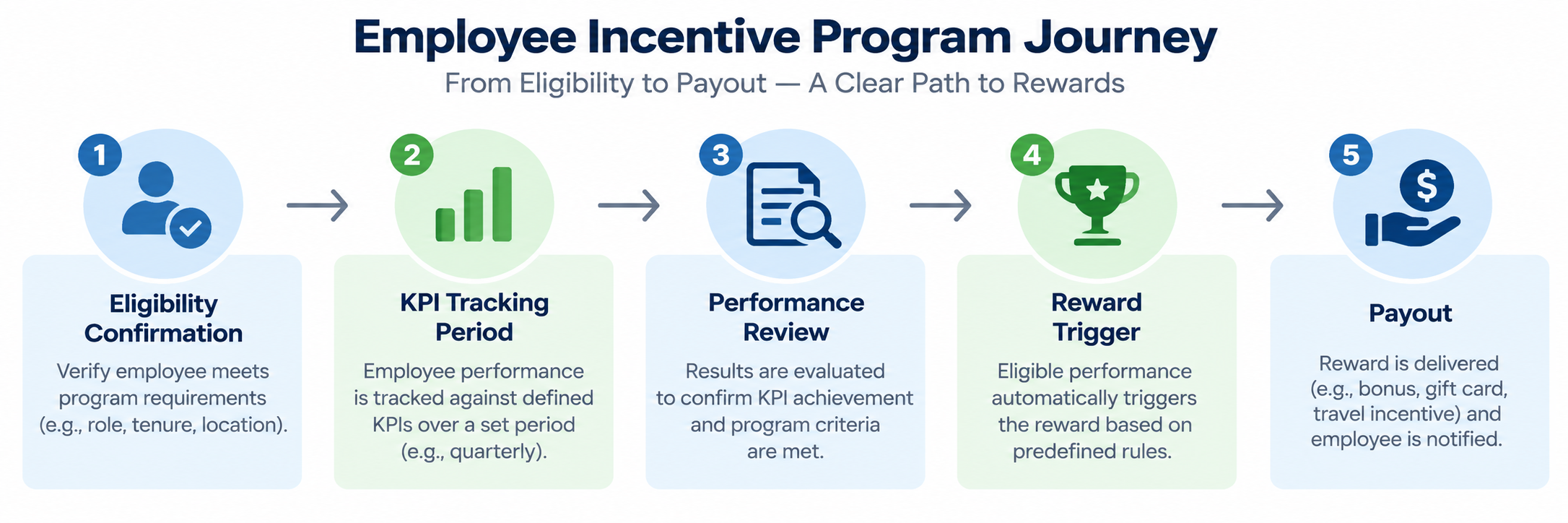
Key performance indicators (KPIs): a clear definition of the metrics you will track, including how each metric is calculated and where the data comes from.
Measurement periods: specific windows, whether monthly, quarterly, or annual, with defined start and end dates.
Rules for payout triggers and clawbacks: clear guidelines on what happens if a participant leaves the organization mid-cycle or if performance data is later found to be inaccurate.
“An effective incentive program doesn’t just reward the top performers; it elevates the baseline performance of the entire team by making success achievable and transparent.”
Budgeting and Proving ROI to Leadership
The budget section is where most proposals either win or lose the room. A CFO’s first reaction when reviewing a new program is to find the line item and ask what happens if performance does not improve. Your job is to answer that question before it’s asked by presenting a self-funding incentive model that ties every dollar of reward spend directly to the incremental revenue or cost savings the program generates.
The mechanics of a self-funding model are simple to manage. You establish a baseline, which is what the team produces without the program, and then define the incremental performance threshold above which payouts are triggered. Rewards are funded from a percentage of the value created above that threshold, which means the program only costs money when it’s working. A sales team that generates $500,000 in incremental quarterly revenue above baseline, for example, might fund a reward pool worth 8 to 12% of that figure. The organization nets the remaining 88 to 92% as pure gain. This is a win-win. That framing converts the budget conversation from “how much will this cost?” to “how much of the upside are we willing to share to capture the rest?”
To calculate ROI for the proposal, compare the total projected cost of rewards and administration against the projected incremental business gains over the same period. Include both direct gains, like revenue, units sold, or contracts closed, and indirect gains where you can quantify them, such as reduced turnover cost or faster onboarding cycles. Presenting a conservative, moderate, and optimistic scenario gives leadership a range to evaluate rather than a single number to argue with, and it signals that you’ve stress-tested your own assumptions.
Need help structuring your program’s budget? Contact Incentives Marketplace to learn how we help companies design self-funding reward structures that deliver results that matter.
Structuring Your Incentive Program Proposal Document
With your objectives, reward structure, eligibility criteria, and budget model defined, the actual document comes together more quickly than most people expect. The key is ordering the sections so that each one builds the case for the next, rather than presenting a flat list of program details. Structure drives persuasion.
A complete incentive program proposal document should include:
Executive Summary: a one-page overview of the program’s purpose, target participants, projected ROI, and the specific business problem it addresses. This is what gets read first and often read alone, so it needs to stand on its own.
Program Objectives: the two or three specific, measurable business goals the program is designed to move, with context on why those goals matter now.
Target Audience and Eligibility: a clear description of who participates, how eligibility is determined, and what criteria govern entry and exit from the program.
Reward Structure: the types of rewards offered (monetary, non-monetary, and recognition-based), the payout frequency, and how reward levels scale with performance.
Budget and ROI Forecast: the financial model, including the self-funding mechanism, baseline assumptions, incremental gain projections, and a cost-per-outcome estimate.
Measurement and Governance: how performance data will be collected and verified, who owns program administration, how disputes are resolved, and what the review cadence looks like for ongoing optimization.
Presenting Your Proposal to Senior Leadership
Writing a strong proposal and presenting it effectively are two different skills, and confusing them is a common mistake. The document is your evidence base. The presentation is your argument. When you walk into the room with the executive team or the CFO, the goal isn’t to walk them through every section: the goal is to make the business case clearly and quickly, then invite scrutiny.
Lead with the outcome, not the mechanism. Most leaders don’t need to understand how a points-based reward platform works before they decide whether to fund it. They need to understand what problem the program solves, what it will cost relative to what it will generate, and who owns accountability for results. Open with those three things, and save the design details for the Q&A.
Aligning your proposal with the organization’s existing objectives and key results (OKRs) is one of the most effective ways to preempt resistance. When leadership can see that your program directly supports a strategic priority they’ve already committed to, such as a revenue target, a retention goal, or a customer satisfaction benchmark, the conversation shifts from “should we do this?” to “how do we implement this well?” That alignment also gives you a governance framework for the program itself, because you’re measuring success against goals the organization has already agreed matter.
Frequently Asked Questions About Incentive Proposals
What is an incentive program proposal?
An incentive program proposal is a formal document designed to pitch a structured rewards initiative to company decision-makers. It outlines the program’s objectives, target participants, budget, reward mechanisms, and ROI measurement strategies to secure executive buy-in. The document functions as both a business case and a design blueprint: it needs to answer the financial questions a CFO will ask while also giving program administrators enough detail to execute.
How do you write a persuasive incentive proposal?
Persuasion in a proposal comes from alignment, not enthusiasm. Alignment builds trust. Focus on connecting the program directly to core business objectives, and prove financial viability before anyone asks. Clearly define your KPIs, build a self-funding budget model that shows payouts are dependent on performance gains, and demonstrate with baseline data how the program will drive measurable results. Proposals that fail usually do so because they lead with the reward experience rather than the business outcome.
What are the key components of an employee incentive plan proposal?
A complete proposal includes an executive summary, clearly defined program goals, participant eligibility criteria, reward structures covering both monetary and non-monetary options, a detailed budget with ROI projections, and a measurement and tracking methodology. Each component serves a specific audience within the approval process: the executive summary is for the C-suite, the eligibility and KPI sections are for HR and legal, and the budget model is for finance. Writing with that audience segmentation in mind makes the document more effective at every level of review.
How do you choose the right rewards for an incentive program?
Start with what you know about your target participants, including their role, their existing compensation structure, and what they’ve responded to in the past. A mix of monetary incentives like bonuses and non-monetary rewards such as travel incentives, employee gifts, or extra time off tends to outperform either category alone, because it addresses both extrinsic and intrinsic motivation. Surveys and focus groups are underused tools here; asking participants directly what they value before the program launches produces better reward design and stronger buy-in from the people the program is meant to serve. For a deeper look at what makes effective incentive programs work across different team structures, the design principles matter as much as the reward catalog.
How do you measure the success of an incentive program?
Measurement starts before the program launches, not after. Establish your baseline, which is the team’s actual performance output over the two to four quarters preceding the program, and document it formally in the proposal. Once the program is live, track your selected KPIs against that baseline at each measurement interval. At the end of the program cycle, compare the incremental revenue or productivity gains against the total cost of rewards and administration. That comparison gives you the program’s true ROI, which is the number you’ll need when you go back to leadership to request renewal or expansion.
Contact Incentives Marketplace Today
Drafting a complete proposal is the first step toward transforming your team’s performance. We help you turn appreciation into performance, and our practical solutions simplify the process from day one. Once you’ve secured leadership’s approval, the harder work begins: translating a well-written document into a program that runs cleanly, rewards fairly, and produces the results you projected. That means reliable reward sourcing, consistent performance tracking, and an administrative structure that doesn’t collapse under its own weight when the first payout cycle arrives. Partnering with an expert makes your program easy to implement, removing the guesswork so you can focus on your goals.
Ready to turn your proposal into a high-performing reality? Contact Incentives Marketplace today to discover how our flexible programs can help you drive results that matter.
Choosing the right incentive program software can make the difference between a rewards initiative that produces measurable results and one that quietly loses participation over time. The market is filled with platforms promising advanced dashboards, automated workflows, extensive integrations, and seemingly endless customization. While these capabilities may sound impressive, businesses should focus first on the features that directly support their goals and improve the participant experience. The most effective software makes it easier to manage incentives, communicate expectations, track performance, and deliver rewards that people genuinely value. It should serve employees, sales representatives, distributors, resellers, franchise partners, or other participants without adding unnecessary administrative work. Before comparing platforms, organizations should identify which features will meaningfully improve motivation, engagement, and business performance.
Start With Your Incentive Program Goals
Software should support the strategy behind an incentive program, not define it. Before evaluating platforms, clarify what the organization wants participants to accomplish. A sales incentive program may focus on increasing revenue, improving margins, selling a specific product, or acquiring new accounts. A channel incentive program may be designed to encourage reseller participation, strengthen distributor loyalty, or improve product knowledge. Employee recognition programs may prioritize retention, appreciation, service anniversaries, peer recognition, or values-based behavior.
Clear objectives make it easier to distinguish essential capabilities from attractive but unnecessary extras. For example, a sales team may need real-time performance tracking and leaderboards, while an employee recognition program may benefit more from manager approvals, milestone automation, and peer-to-peer recognition tools. Incentives Marketplace supports business-focused programs across sales, channel, travel, employee recognition, and B2B loyalty use cases. When software is aligned with a defined purpose, every feature can be evaluated according to whether it helps produce the desired outcome.
A Simple and Engaging Participant Experience
Participant usability is one of the most important features of any incentive platform. Even a powerful system will underperform when users find it confusing, slow, or inconvenient. Participants should be able to sign in easily, understand how the program works, see what they have earned, and determine what they need to do next. The platform should make progress visible without forcing users to search through complicated menus.
A strong participant experience generally includes:
A clear, intuitive dashboard
Mobile-friendly access
Easy account registration and login
Visible point balances or achievement status
Simple reward browsing and redemption
Clear program rules and qualification requirements
Personalized messages and notifications
The participant interface should also reflect the organization’s brand and program purpose. A program for high-performing sales representatives may need an energetic, competitive environment, while an employee recognition platform may require a more inclusive and celebratory experience. Ease of use is not merely a design preference. It directly influences whether participants return to the platform, track their progress, and remain engaged.
Flexible Performance Tracking
Reliable tracking is central to effective incentive program software. Businesses need a way to connect participant actions with program goals, whether those actions involve sales volume, completed training, product adoption, referrals, safety milestones, attendance, or other measurable behaviors. The platform should accommodate the specific metrics that matter to the organization rather than forcing every program into the same structure.
Look for software that can support individual, team-based, and organizational goals. It should also handle different earning rules, qualification periods, achievement levels, and participant groups. A company may want to award points for every eligible sale, provide bonuses after a certain threshold, or create separate goals for different territories. Flexible tracking allows program managers to design these structures without relying on extensive manual calculations.
Timely updates also matter. When participants can see their progress shortly after completing an eligible action, the connection between performance and reward becomes stronger. Long reporting delays can weaken motivation and create questions about whether activities were recorded correctly.
Meaningful Reporting and Analytics
A dashboard filled with charts is not automatically useful. Reporting features matter when they help program managers evaluate performance and make better decisions. The platform should show whether participation is growing, which activities are driving results, how rewards are being used, and where engagement is declining.
Useful reports may include:
Participant enrollment and activity
Goal completion rates
Sales or performance changes
Point issuance and redemption
Reward selection trends
Engagement by department, location, or partner type
Program spending and remaining budget
High-performing and inactive participant segments
Reporting should be understandable without requiring specialized technical knowledge. Managers should be able to filter information, export relevant data, and share results with stakeholders. Ideally, the software should help connect incentive activity to business outcomes rather than focusing exclusively on platform logins or reward redemptions. Participation metrics are valuable, but decision-makers also need to know whether the program is influencing the behaviors it was created to improve.
Reward Choice and Catalog Flexibility
Rewards are a visible part of the participant experience, so the platform should provide options that appeal to different people. A limited catalog can make even a well-designed program feel restrictive. Participants have different preferences, lifestyles, locations, and ideas about what constitutes a meaningful reward. Software that supports varied reward categories gives participants greater control over the value they earn.
Common reward options include:
Digital gift cards
Merchandise
Travel experiences
Individual getaways
Group incentive travel
Premium recognition awards
Experiential rewards
Points-based catalogs
Incentives Marketplace offers reward options that can include merchandise, gift cards, points-based catalogs, travel incentives, recognition rewards, and premium experiences. The right mix depends on the audience and the level of achievement being recognized. Digital rewards may work well for frequent, smaller accomplishments, while travel can provide an aspirational reward for major sales achievements or annual recognition programs.
Catalog variety should not come at the expense of usability. Participants should be able to search, filter, compare, and redeem rewards without confusion. Program managers should also be able to establish redemption rules and control which reward options are available to different participant groups.
Strong Communication Tools
An incentive program cannot motivate participants who forget that it exists. Built-in communication features help organizations promote the program, clarify its rules, celebrate achievements, and maintain momentum. Messages should reach participants at meaningful points throughout the program rather than only during enrollment or reward redemption.
Effective communication tools may support:
Welcome messages
Goal reminders
Progress notifications
New promotion announcements
Achievement confirmations
Leaderboard updates
Reward redemption notices
Expiration alerts
Recognition messages
Personalization makes these communications more relevant. A participant who is close to reaching a goal should receive a different message from someone who has not engaged in several weeks. The software should allow administrators to segment audiences and tailor communications based on status, behavior, role, location, or program type. These capabilities can help turn the platform into an ongoing engagement channel rather than a passive reward website.
Automation That Reduces Administrative Work
Automation is valuable when it removes repetitive tasks without reducing program control. Incentive administrators should not have to manually process every achievement, update every point balance, or send every notification. The software should simplify routine activities so managers can focus on program strategy, participant support, and performance analysis.
Helpful automation features may include:
Automatic point calculations
Scheduled communications
Milestone and anniversary recognition
Participant enrollment workflows
Reward fulfillment updates
Approval routing
Eligibility validation
Recurring reports
Inactivity reminders
The right approval structure is particularly important. Some programs can issue rewards automatically after verified actions, while others require manager review or supporting documentation. Software should allow the organization to establish the appropriate level of oversight for each program. Automation should improve efficiency while preserving accuracy, fairness, and budget control.
Integration With Existing Business Systems
Incentive program software rarely operates in isolation. It may need information from customer relationship management platforms, human resources systems, learning management systems, sales databases, payroll tools, or distributor portals. Reliable integrations can reduce duplicate data entry and help ensure that participant records and performance results remain current.
The importance of each integration depends on the program. A sales incentive system may need CRM data, while employee recognition software may require HR information about departments, managers, hire dates, and service milestones. Channel programs may depend on transaction files from distributors or resellers. Before selecting a platform, businesses should identify where participant and performance data currently reside.
Ask vendors how information is transferred, how frequently it is updated, and what happens when errors occur. A long list of available integrations is less important than dependable compatibility with the systems the organization actually uses. The implementation process should also include clear responsibilities for data mapping, testing, security, and ongoing maintenance.
Security, Permissions, and Program Controls
Incentive platforms may contain employee records, partner information, sales results, reward balances, and other sensitive business data. Security should therefore be treated as a core requirement, not an optional technical feature. Businesses should understand how data is stored, transferred, protected, and accessed.
Role-based permissions are especially important. Participants, managers, program administrators, finance teams, and executives may each need different levels of access. A manager may need to approve awards for direct reports, while a program administrator may need broader control over rules, communications, and reporting. The software should prevent users from seeing or modifying information outside their responsibilities.
Program controls should also help manage budgets and reduce errors. Administrators may need limits on point issuance, approval requirements for high-value rewards, audit histories, or alerts for unusual activity. These features protect both the organization and its participants while supporting consistent program administration.
Scalability and Customization
A platform should meet current needs while leaving room for the program to evolve. A business may begin with a sales contest for one department and later expand into employee recognition, distributor loyalty, franchise incentives, or travel rewards. Replacing the entire platform every time the program changes can be disruptive and expensive.
Scalable software should support more participants, additional program types, new reward structures, and changing business rules. It should also accommodate multiple departments, locations, brands, or partner groups when needed. However, scalability should not be confused with excessive complexity. Organizations should not pay for enterprise-level capabilities that they are unlikely to use.
Customization should focus on meaningful elements such as branding, earning rules, communications, workflows, participant groups, and reward options. Deep customization can be useful, but it may also increase implementation time and maintenance requirements. The best balance is usually a flexible platform that can be configured around the organization’s strategy without requiring extensive custom development.
Reliable Support and Strategic Guidance
Software features alone do not guarantee a successful incentive program. Organizations may need help structuring earning rules, selecting rewards, communicating with participants, reviewing results, and adjusting the program over time. Responsive support is therefore one of the most valuable considerations when evaluating a provider.
Ask who will assist during implementation and after launch. Determine whether support is limited to technical troubleshooting or includes strategic program guidance. A strong incentive partner should understand the differences between sales teams, employees, distributors, resellers, and franchise networks. Each audience may respond to different goals, communications, and rewards.
Support is particularly important when a program includes travel incentives or complex reward experiences. Travel programs can require participant communication, qualification tracking, destination planning, and logistical coordination. Incentives Marketplace helps organizations create travel programs connected to sales achievement, employee recognition, channel partner rewards, and other business goals. A knowledgeable partner can help keep both the technology and the participant experience aligned with the value of the achievement.
Features That May Matter Less Than They Seem
Some features look impressive in demonstrations but provide limited practical value. Complex gamification, excessive customization, or dozens of rarely used reports can make a platform harder to manage. Businesses should avoid choosing software based on the total number of features listed on a comparison chart.
Instead, evaluate whether each capability answers a real need. Consider asking:
Will participants use this feature regularly?
Does it reduce administrative effort?
Does it improve measurement or decision-making?
Does it support our most important program goal?
Can our team manage it effectively?
Will it remain useful as the program grows?
A simpler system that performs essential tasks reliably may deliver more value than a complicated platform with numerous unused tools. The goal is not to purchase the software with the longest feature list. It is to choose a solution that makes the incentive program easier to use, manage, measure, and improve.
Frequently Asked Questions
What is incentive program software?
Incentive program software is a digital platform used to manage goals, track participant performance, issue rewards, communicate updates, and measure program results.
Who can use an incentive platform?
Businesses can use incentive platforms for employees, sales representatives, distributors, resellers, franchise partners, dealers, and other B2B audiences.
What is the most important software feature?
The most important feature is alignment with the program’s goals. The platform should make it easy to track desired behaviors and reward participants appropriately.
Should incentive software include a reward catalog?
A flexible reward catalog is highly valuable because it gives participants choices that match their preferences, achievement levels, and locations.
Can incentive software support multiple programs?
Many platforms can manage sales incentives, channel programs, employee recognition, loyalty initiatives, and travel rewards within one system. The exact capabilities vary by provider.
Does the software need to integrate with a CRM?
CRM integration is useful for sales programs that depend on customer, opportunity, or transaction data. It may not be necessary for every incentive initiative.
How should businesses measure program success?
Businesses should compare participation, performance changes, reward activity, program costs, and progress toward the original business objectives.
Are travel incentives managed differently from merchandise rewards?
Yes. Travel rewards typically require more planning, communication, qualification management, and logistical support than standard merchandise or digital rewards.
Build a More Effective Program With Incentives Marketplace
The best incentive program software is not necessarily the platform with the most complicated technology. It is the solution that connects measurable goals with a clear participant experience, flexible rewards, reliable tracking, useful reporting, and manageable administration. Businesses should prioritize the features that help people understand what they can achieve, remain motivated throughout the program, and receive rewards that feel meaningful.
Incentives Marketplace provides flexible corporate incentive solutions for organizations that want stronger results from their sales incentive programs, channel incentive programs, travel incentives, employee recognition programs, and B2B loyalty initiatives. We help businesses motivate employees, distributors, resellers, franchise partners, and other important audiences through thoughtfully structured programs. From merchandise and reward catalogs to digital gift cards and memorable travel experiences, our solutions make it easier to connect recognition and motivation with measurable business objectives. Let us help you create an incentive program that fits your audience, supports your strategy, and is designed to grow with your organization. Get started with us today.
A well-planned incentive program can help manufacturers increase sales, strengthen channel relationships, improve employee performance, and encourage desired behaviors across the organization. However, even the most exciting rewards will not produce sustainable results without a realistic financial plan. Calculating a manufacturer incentive budget requires more than choosing a round number or copying last year’s spending. Manufacturers need to connect program costs to specific business objectives, participant behavior, expected revenue, and measurable returns.
The right budget should be large enough to motivate participants without creating unnecessary financial risk. It should also account for expenses beyond the rewards themselves, including technology, communications, fulfillment, administration, and reporting. By taking a structured approach, manufacturers can build incentive programs that are financially responsible, engaging, and aligned with long-term growth goals.
Start With a Clear Incentive Program Objective
Before calculating costs, determine exactly what the incentive program is intended to accomplish. A program designed to increase distributor sales will have a different budget structure than one created to recognize employees or reward franchise partners.
Common manufacturing incentive program goals include:
Increasing sales of a specific product
Growing revenue in an underperforming territory
Encouraging distributors to stock additional inventory
Motivating resellers to prioritize one brand over competitors
Promoting new product launches
Improving employee productivity or safety
Increasing participation in training programs
Strengthening distributor and dealer loyalty
Encouraging cross-selling or upselling
Reducing employee turnover
Objectives should be specific and measurable. Instead of setting a broad goal such as “increase sales,” a manufacturer might aim to increase sales of a particular product line by 12 percent within six months. A precise objective makes it easier to estimate the program’s potential financial impact and determine how much the company can responsibly invest.
Identify Who Will Participate
The number and type of participants will significantly affect the total manufacturer incentive budget. Manufacturers may create programs for employees, sales representatives, distributors, dealers, resellers, franchise partners, contractors, or multiple groups at once.
Begin by estimating the total eligible audience. Then determine how many participants are likely to enroll, actively engage, and earn rewards. Not every eligible participant will complete the behaviors required to receive an incentive.
For example, a manufacturer may invite 2,000 distributor sales representatives to participate but expect only 60 percent to enroll. Of those 1,200 enrolled participants, perhaps 40 percent will achieve at least one reward level. These participation assumptions help the manufacturer avoid budgeting as though every eligible person will earn the maximum reward.
Consider dividing participants into segments based on factors such as:
Sales volume
Geographic region
Role or job function
Distributor tier
Experience level
Historical program participation
Revenue potential
Product specialization
Segmentation can make the program more relevant while also giving manufacturers greater control over spending. High-potential participants may receive more challenging goals and higher-value rewards, while occasional sellers may be offered accessible entry-level incentives.
Establish the Financial Value of the Desired Outcome
An incentive program should generate value that exceeds its total cost. To estimate an appropriate budget, calculate the financial benefit of the behavior the company wants to encourage.
Suppose a manufacturer wants to generate $1,000,000 in incremental product sales. If the gross margin on those sales is 30 percent, the expected gross profit would be $300,000. The incentive program budget should generally represent only a portion of that amount, allowing the manufacturer to retain enough profit to justify the campaign.
$1,000,000 × 30% = $300,000 in incremental gross profit
The manufacturer can then decide what percentage of the incremental gross profit to allocate to the program. If the company allocates 20 percent, the preliminary budget would be:
$300,000 × 20% = $60,000
This amount is not automatically the final budget. It is a starting point that must also cover technology, administration, communications, rewards, fulfillment, and other expenses.
Manufacturers should use profit rather than revenue alone when evaluating affordability. A program that generates significant sales may still be unprofitable if product margins are low or rewards are too expensive.
Choose an Incentive Structure
The incentive structure determines when participants qualify for rewards and how much the manufacturer may need to spend. Manufacturers can choose from several common approaches.
Open-Ended Programs
In an open-ended program, every participant who meets the required criteria earns a reward. These programs can be highly motivating because participants are not competing for a limited number of prizes.
However, open-ended programs require careful forecasting. If participation or performance is stronger than expected, reward expenses may exceed initial estimates. Manufacturers can manage this risk by setting clear qualification rules, maximum earning limits, and defined program dates.
Closed-Ended Programs
A closed-ended program offers rewards to a predetermined number of winners. For example, the top 20 distributor sales representatives may earn a group travel experience.
This structure makes reward costs easier to predict because the number of winners is fixed. However, it may be less motivating for lower-performing participants who believe they have little chance of reaching the top.
Tiered Programs
Tiered programs provide increasingly valuable rewards as participants reach higher performance levels. A distributor representative might earn a digital gift card at the first level, merchandise at the second level, and a travel reward at the highest level.
Tiered structures can engage a wider range of participants because they provide achievable milestones. They also allow manufacturers to match reward value with the financial value generated at each level.
Points-Based Programs
Points programs award participants for completing specific behaviors, such as selling products, completing training, submitting sales data, or participating in promotions. Participants can later redeem accumulated points from a reward catalog.
Points-based programs offer flexibility and can support long-term engagement. Manufacturers must estimate the value of points issued, the expected redemption rate, and any unredeemed point liability.
Calculate the Reward Budget
Rewards often represent the largest portion of a manufacturer incentive budget. To estimate this cost, determine the expected number of earners and the average reward value.
A simple formula is:
Expected Number of Reward Earners × Average Reward Cost = Estimated Reward Budget
For example, assume a manufacturer expects 500 participants to earn an average of $100 in rewards:
500 × $100 = $50,000
For a tiered program, calculate each reward level separately:
300 participants earn a $50 reward: $15,000
150 participants earn a $150 reward: $22,500
50 participants earn a $500 reward: $25,000
The estimated total reward cost would be $62,500.
Manufacturers should also account for the difference between the perceived value and the actual cost of rewards. A desirable merchandise item, travel experience, or carefully curated reward catalog may feel more valuable to participants than a comparable cash payment. This can help the company create a memorable experience without relying solely on higher monetary amounts.
Include Technology and Platform Costs
Modern incentive programs often depend on a digital platform for participant registration, performance tracking, points management, reward redemption, reporting, and communication. Platform costs may vary based on program size, required features, integrations, and customization.
Potential technology expenses include:
Platform setup
Program configuration
Participant portal development
Custom branding
Data integrations
Sales tracking
Mobile access
Dashboard and reporting tools
Security features
Technical support
Ongoing platform fees
Manufacturers should evaluate technology based on more than the lowest initial price. A platform that improves reporting, reduces manual work, and creates a better participant experience may deliver greater long-term value.
It is also important to determine whether the platform can integrate with existing customer relationship management, enterprise resource planning, human resources, or distributor reporting systems. Integration expenses should be included in the original budget rather than treated as unexpected costs later.
Account for Program Administration
Every incentive program requires oversight. Someone must establish rules, verify results, answer participant questions, manage exceptions, coordinate rewards, and prepare reports.
Administrative expenses may include:
Program strategy and design
Participant enrollment management
Sales claim validation
Customer support
Reward approval
Fraud prevention
Compliance review
Performance reporting
Data analysis
Program adjustments
Vendor coordination
Manufacturers should calculate the internal labor required to manage the program. Even when employees are not paid specifically for incentive administration, their time still represents a real business cost.
Working with an experienced incentive program provider may reduce the internal burden. Outsourced administration can help manufacturers manage complexity, improve consistency, and give internal teams more time to focus on core responsibilities.
Budget for Program Communications
Participants cannot engage with a program they do not understand. Communications should explain how the program works, why participation matters, what rewards are available, and how performance will be measured.
Communication costs may include:
Launch emails
Printed materials
Digital banners
Distributor toolkits
Training materials
Reminder messages
Performance updates
Leaderboards
Promotional videos
Recognition announcements
Program websites or landing pages
Communications should continue throughout the program rather than ending after launch. Regular reminders, progress updates, and recognition messages help maintain momentum.
Manufacturers may also need to tailor communications to different participant groups. A distributor owner may care about revenue growth and market share, while an individual salesperson may respond more strongly to personal rewards and recognition.
Include Fulfillment and Delivery Expenses
Reward costs are not always limited to the listed value of the reward. Physical merchandise may require packaging, shipping, handling, storage, customer service, and return management.
Travel rewards can include airfare, hotels, meals, transfers, activities, insurance, event staffing, and on-site support. Digital gift cards may have delivery, processing, or service costs depending on the program structure.
The budget should account for:
Shipping and handling
Merchandise storage
Replacement shipments
Returns or exchanges
Travel planning
Event management
Taxes or fees
Participant support
Digital reward delivery
International fulfillment
Fulfillment expenses can vary based on the location of participants. A manufacturer with a national or global channel network should consider regional shipping costs, currency issues, customs requirements, and reward availability.
Add a Contingency Reserve
Performance does not always match forecasts. More participants may qualify for rewards than expected, shipping costs may increase, or the program may require additional communications.
A contingency reserve gives manufacturers flexibility to address unexpected expenses without disrupting the program. Many organizations set aside a percentage of the total estimated budget for this purpose.
The appropriate reserve depends on the program’s structure. An open-ended sales incentive may require a larger contingency because reward expenses are tied directly to participant performance. A closed-ended travel program with a fixed number of winners may be easier to predict.
The contingency fund should not replace thoughtful planning. Instead, it should protect the program from reasonable forecasting differences and unavoidable cost changes.
Build a Complete Manufacturer Incentive Budget
A complete budget may be divided into the following categories:
Rewards
Incentive technology
Program setup
Administration
Communications
Training
Data integration
Fulfillment
Travel or event expenses
Taxes and legal review
Reporting and analytics
Contingency reserve
For example, a manufacturer might create a preliminary budget like this:
Rewards: $75,000
Technology and platform fees: $15,000
Administration: $10,000
Communications: $7,500
Fulfillment: $5,000
Reporting and analytics: $2,500
Contingency reserve: $10,000
The total estimated program budget would be $125,000.
This figure should then be compared with expected incremental profit, retention improvements, productivity gains, or other financial outcomes. If the anticipated value does not sufficiently exceed the investment, the manufacturer may need to adjust the program design.
Forecast Different Performance Scenarios
Relying on one forecast can expose the company to unnecessary risk. Manufacturers should model multiple participation and performance scenarios before finalizing the budget.
A practical forecast may include:
Low-participation scenario
Expected-participation scenario
High-participation scenario
Maximum-liability scenario
The low scenario estimates costs if enrollment and performance remain below expectations. The expected scenario reflects the most likely outcome. The high scenario shows what may happen if the program performs particularly well. The maximum-liability scenario calculates the greatest possible expense under the program rules.
This exercise is especially important for open-ended programs. Stronger-than-expected results can be positive, but the organization must have enough financial capacity to honor every earned reward.
Determine the Program’s Break-Even Point
The break-even point identifies how much additional value the program must generate to cover its total cost.
The formula is:
Total Program Cost ÷ Gross Margin Percentage = Required Incremental Revenue
If a manufacturer plans to spend $100,000 and has a gross margin of 25 percent, the program must generate:
$100,000 ÷ 25% = $400,000 in incremental revenue
Revenue above $400,000 would begin contributing positive gross profit, assuming the calculation includes all relevant program costs.
The break-even analysis gives decision-makers a straightforward way to evaluate feasibility. It can also help manufacturers set minimum performance thresholds and determine whether a proposed reward structure is sustainable.
Measure Return on Investment
Once the program begins, manufacturers should compare actual results against the original budget and objectives. Return on investment, or ROI, can be calculated using the following formula:
Program-Generated Profit − Program Cost ÷ Program Cost × 100 = ROI
Suppose a program generates $250,000 in incremental gross profit and costs $100,000:
($250,000 − $100,000) ÷ $100,000 × 100 = 150% ROI
Financial ROI is important, but manufacturers may also track nonfinancial outcomes, including:
Participant enrollment
Active participation
Reward redemption
Distributor retention
Employee engagement
Product training completion
Sales claim accuracy
New account acquisition
Product mix
Market share
Program satisfaction
These measures can show whether the incentive program is improving behaviors that support long-term business performance.
Avoid Common Incentive Budget Mistakes
One of the most common mistakes is budgeting only for rewards. Technology, administration, communication, and fulfillment can represent a meaningful portion of total spending.
Another mistake is setting reward values without considering product margins. A generous incentive may increase sales while reducing profitability. Manufacturers should evaluate the net financial effect of every reward level.
Other common budgeting mistakes include:
Overestimating participation
Underestimating maximum liability
Ignoring administrative labor
Using unclear qualification rules
Failing to account for taxes or compliance
Setting identical goals for unequal participants
Neglecting ongoing communication
Measuring revenue without measuring profit
Launching without a contingency reserve
Failing to review performance during the program
Careful planning helps prevent these issues and makes it easier to explain the investment to leadership.
Review and Adjust the Budget Regularly
An incentive budget should not remain static throughout the program. Manufacturers should review enrollment, performance, reward earnings, redemption patterns, and total costs at regular intervals.
Early monitoring can reveal whether the program is underperforming, exceeding expectations, or attracting unexpected participant behavior. The manufacturer may need to increase communications, clarify rules, adjust future reward levels, or provide additional training.
Changes to an active program should be handled carefully. Participants need consistent rules and confidence that earned rewards will be honored. However, data from the current program can be used to improve future campaigns.
Over time, manufacturers can create more accurate forecasts by comparing actual results across product lines, audiences, territories, and incentive structures.
Frequently Asked Questions
How much should a manufacturer spend on an incentive program?
The amount depends on expected profit, program goals, audience size, reward structure, and administrative costs. The budget should remain comfortably below the value the program is expected to generate.
Should an incentive budget be based on revenue or profit?
Profit is generally the more useful measure. Revenue alone does not reflect product margins or the true financial value of incremental sales.
What is the largest incentive program expense?
Rewards are often the largest expense, but technology, administration, communication, travel, and fulfillment can also represent high costs.
How can manufacturers control incentive costs?
Manufacturers can use qualification thresholds, reward caps, tiered structures, fixed winner counts, realistic participation forecasts, and maximum-liability calculations.
What is a maximum-liability calculation?
It is the total cost the company could face if every eligible participant earned the highest reward allowed under the program rules.
Should a budget include a contingency reserve?
Yes. A contingency reserve can cover higher participation, additional communications, fulfillment changes, and other unexpected expenses.
How often should manufacturers review program spending?
Program spending should be reviewed regularly throughout the campaign. Monthly or quarterly reviews may be appropriate depending on the program’s length and complexity.
Can incentive program software help manage the budget?
Yes. A modern incentive platform can track participant activity, reward earnings, redemptions, program liability, and performance against goals.
Build a Smarter Incentive Program With Incentives Marketplace
A successful manufacturer incentive budget balances motivation, affordability, and measurable business value. By defining clear goals, estimating participation, calculating expected profit, planning for every cost category, and monitoring performance, manufacturers can create programs that reward meaningful results without losing control of spending.
Incentives Marketplace provides flexible solutions for organizations that want stronger results from sales incentive programs, channel incentive programs, travel incentives, and employee recognition programs. Corporate incentive programs can help businesses drive performance, improve engagement, and build stronger relationships with employees, distributors, resellers, and franchise partners.
From extensive reward catalogs and merchandise to memorable travel experiences and convenient digital gift cards, we make it easier to align participant motivation with measurable business goals. Contact us and get started today.
Choosing the right incentive program platform can make a major difference in how effectively your organization motivates employees, sales teams, channel partners, customers, and other key audiences. A well-designed platform does more than distribute rewards. It helps you set clear goals, track performance, encourage participation, simplify administration, and create meaningful experiences that make people feel valued.
But with so many options available, it can be difficult to know what to look for. Some platforms focus mainly on gift cards. Others offer employee recognition tools, sales incentive tracking, loyalty programs, merchandise rewards, travel options, or custom program management. The best choice depends on your business goals, audience, budget, internal resources, and long-term growth plans.
This buyer’s guide will walk you through the most important factors to consider when selecting an incentive program platform, so you can make a confident and informed decision.
Start With Your Program Goals
Before comparing vendors, take time to define what you want your incentive program to accomplish. The right platform should support your business objectives, not force your strategy into a limited system.
Common incentive program goals include:
Increasing sales performance
Motivating channel partners
Improving employee engagement
Recognizing top performers
Encouraging customer loyalty
Supporting safety, wellness, or training initiatives
Driving participation in specific business campaigns
Rewarding milestone achievements
Reducing turnover
Building a stronger workplace culture
Once your goals are clear, you can evaluate platforms based on how well they help you achieve those outcomes. For example, a sales incentive program may require leaderboards, goal tracking, and performance reporting. An employee recognition program may need peer-to-peer recognition, manager approval workflows, and anniversary rewards. A customer loyalty program may require enrollment tools, purchase tracking, and redemption options.
A strong incentive program platform should be flexible enough to match your goals today and adapt as those goals change.
Understand Your Audience
Your incentive program is only successful if people actually want to participate. That means your platform should be designed around the needs, preferences, and expectations of the people you want to motivate.
Ask questions such as:
Who will use the program?
Are participants employees, salespeople, dealers, distributors, customers, or multiple groups?
Are users desk-based, remote, mobile, or in the field?
What types of rewards would feel meaningful to them?
How tech-savvy is the audience?
Will they need access from mobile devices?
Are there multiple languages, locations, or regions to consider?
The best programs feel easy, relevant, and rewarding to the participant. If the platform is confusing or the rewards are uninspiring, engagement will suffer. Look for a solution that makes the experience simple from login to redemption.
Look for a Reward Assortment That Motivates Everyone
Reward choice is one of the most important parts of any incentive program. People are motivated by different things, and a one-size-fits-all reward catalog rarely delivers the best results.
A quality incentive program platform should offer a wide range of reward options, such as:
Name-brand merchandise
Gift cards
Travel experiences
Event tickets
Lifestyle products
Electronics
Home goods
Outdoor and recreational items
Charitable giving options
Custom rewards
The broader and better curated the assortment, the easier it is for participants to find something they genuinely want. This matters because the perceived value of a reward often depends on personal preference. A reward that excites one person may not motivate another.
It is also important to consider reward quality. A large catalog is helpful, but only if the options are relevant, appealing, and reliable. Look for a provider that carefully selects rewards and regularly updates the assortment.
Evaluate Ease of Use
A platform can have excellent features, but if it is difficult to use, your team and participants may not fully adopt it. Ease of use should be a priority for both administrators and participants.
For participants, the platform should make it simple to:
View available rewards
Track progress toward goals
Understand how to earn points or rewards
Redeem rewards quickly
Receive updates and communications
Access support when needed
For administrators, the platform should make it easy to:
Launch and manage campaigns
Add or update participants
Set goals and rules
Approve rewards
Track performance
Generate reports
Communicate with users
Manage budgets
A good platform reduces administrative burden rather than adding to it. If your team has to spend too much time managing spreadsheets, answering basic user questions, or manually tracking results, the platform may not be doing enough.
Ask About Customization and Branding
Your incentive program should feel like an extension of your company, not a generic third-party tool. Branding and customization help create a more professional, cohesive, and engaging experience.
Look for options such as:
Custom program name and branding
Company logo and colors
Personalized landing pages
Custom communications
Audience-specific reward catalogs
Tailored earning rules
Custom approval workflows
Program themes for campaigns or events
Customization is especially important if the program will be used with employees, customers, or channel partners. A branded experience builds trust and reinforces the purpose behind the program.
Consider Reporting and Analytics
An incentive program should produce measurable results. That is why reporting and analytics are essential when choosing an incentive program platform.
At a minimum, your platform should help you understand:
Who is participating
Which activities are driving engagement
Which rewards are most popular
How performance is trending over time
Whether goals are being met
How reward spending compares to results
Which departments, teams, regions, or partners are performing best
The more insight you have, the easier it is to improve your program. Strong reporting allows you to identify what is working, adjust what is not, and prove the value of the program to leadership.
If your incentive program is tied to sales, customer retention, productivity, or other business outcomes, ask whether the platform can connect incentive activity to performance data. This can help you understand return on investment more clearly.
Review Integration Capabilities
Depending on your organization, your incentive platform may need to connect with other systems. These could include customer relationship management software, human resources systems, learning management systems, sales tracking tools, payroll platforms, or e-commerce systems.
Helpful integrations may include:
CRM systems
HRIS platforms
Sales performance tools
Learning management systems
Single sign-on
Payroll or finance systems
Customer loyalty systems
Data feeds from internal platforms
Integrations can reduce manual work, improve accuracy, and make the program easier to scale. Before choosing a provider, ask what integrations are available and how data is transferred, protected, and updated.
Prioritize Support and Program Expertise
Technology is important, but support and expertise are just as valuable. Many organizations need more than a platform. They need a partner who understands incentive strategy, program design, reward fulfillment, communication, engagement, and measurement.
A strong provider should be able to help with:
Program strategy
Goal setting
Reward selection
Participant communication
Launch planning
Ongoing optimization
Reporting and analysis
Customer service
Award fulfillment
Troubleshooting
This is especially important if your team does not have the internal time or experience to manage every detail. The right partner can help you avoid common mistakes, improve participation, and keep the program running smoothly.
Check Fulfillment Reliability
Reward fulfillment has a major impact on participant satisfaction. When someone earns a reward, they expect it to arrive correctly and on time. Delays, limited inventory, poor communication, or low-quality items can damage trust in the program.
Ask potential providers about:
Shipping timelines
Inventory management
Order tracking
Replacement policies
Customer service processes
International fulfillment options
Vendor relationships
Quality control
Fulfillment becomes even more important as programs grow. If your organization expects high reward volume, choose a provider with the experience, infrastructure, and partner network to handle it reliably.
Compare Pricing and Value
Pricing can vary widely among incentive program platforms. Some providers charge setup fees, monthly software fees, transaction fees, fulfillment fees, or markups on rewards. Others use performance-based models.
When reviewing pricing, look beyond the basic cost. Consider the total value you receive, including:
Platform capabilities
Reward assortment
Administrative support
Reporting tools
Customization
Fulfillment reliability
Customer service
Program strategy
Scalability
Expected return on investment
A lower-cost platform may not be the best option if it requires more internal labor, offers limited rewards, or fails to drive engagement. The best value is the platform that helps you achieve meaningful results with the least friction.
Think About Scalability
Your incentive program may start with one audience or one campaign, but your needs could expand over time. Choose a platform that can grow with you.
Scalability may include:
Adding more participants
Supporting multiple programs
Expanding to new locations
Creating different reward catalogs
Managing several audiences
Handling higher reward volume
Supporting more complex rules
Offering advanced reporting
A scalable incentive program platform gives you room to grow without having to switch providers later.
Look for Security and Compliance
Any platform that stores user information, performance data, or transaction details should take security seriously. Ask providers how they protect participant data and what safeguards are in place.
Important areas to review include:
Data privacy practices
Secure login options
Role-based permissions
Data encryption
Compliance with applicable regulations
User access controls
Secure reporting
Vendor management practices
Your incentive program should be easy to use, but it should also protect your organization and participants.
Questions to Ask Before Choosing a Platform
Before making a final decision, ask each provider a consistent set of questions. This will help you compare options fairly.
Useful questions include:
What types of incentive programs do you support?
Can the platform be customized for our brand and goals?
What reward options are available?
How often is the reward catalog updated?
What reporting tools are included?
Can the platform integrate with our existing systems?
What support is available during launch and after launch?
How is reward fulfillment handled?
What fees should we expect?
Can the platform scale as our program grows?
How do you help clients measure success?
What makes your approach different?
The answers should give you a clearer sense of whether the provider is simply offering software or acting as a true incentive partner.
Common Mistakes to Avoid
Choosing an incentive platform is easier when you know what pitfalls to watch for. Avoid these common mistakes:
Choosing based on price alone
Overlooking the participant experience
Selecting a reward catalog that is too limited
Failing to define goals before launch
Ignoring reporting and measurement
Underestimating administrative workload
Forgetting about fulfillment quality
Choosing a platform that cannot scale
Launching without a communication plan
Treating incentives as a one-time campaign instead of an ongoing strategy
A successful program requires the right mix of technology, rewards, communication, support, and measurement.
FAQ
What is an incentive program platform?
An incentive program platform is a system used to manage, track, and reward desired behaviors or performance.
Who can use an incentive program platform?
Businesses can use one for employees, sales teams, channel partners, customers, dealers, distributors, and other key audiences.
What types of rewards should a platform offer?
A strong platform should offer a wide range of rewards, including merchandise, gift cards, travel, experiences, and custom options.
How important is reward choice?
Reward choice is very important because different people are motivated by different things.
Should the platform include reporting?
Yes. Reporting helps you track participation, performance, reward activity, and program results.
Can incentive platforms support sales growth?
Yes. Many platforms are designed to motivate sales teams, channel partners, and customers to take actions that support growth.
Is customization important?
Yes. Custom branding, program rules, communications, and reward options can make the experience more relevant and engaging.
How do I know if a platform is easy to use?
Ask for a demo and review the experience from both the administrator and participant perspective.
What should I ask about fulfillment?
Ask about shipping, tracking, inventory, replacement policies, customer support, and reward quality.
What is the most important factor when choosing a platform?
The most important factor is fit. The platform should match your goals, audience, budget, and long-term strategy.
Choose a Partner That Helps You Create Real Results
The right incentive program platform should do more than process rewards. It should help your organization engage people, inspire action, and celebrate meaningful achievements. When your program is easy to manage, exciting to use, and built around measurable goals, incentives become a powerful tool for business growth.
Incentives Marketplace has been helping clients engage, inspire, and reward the people most important to their business for over 21 years. Our expertise, resources, and support help companies grow sales, engage employees and channel partners, and create loyal customers. We succeed when our clients do, and we are only paid when our clients see results.
With our partner, we ship over 1 million awards each year to people who deserve recognition for their outstanding accomplishments. With over 13,000 incentive options, each carefully selected by experts, our assortment works for businesses of all sizes. Our client list includes Fortune 500 companies as well as regional companies with fewer than 100 employees.
Ready to build an incentive program that motivates the right people and delivers measurable results? Contact us to learn how we can help you create a program that works for your business.