How to Write an Incentive Program Proposal That Gets Approved
Most incentive program proposals falter before they reach a vote. Not because the program idea is weak, but because the document reads like a wish list rather than a business case. They want business cases. Executives and CFOs aren’t opposed to investing in people; they’re opposed to funding something they can’t measure, model, or connect to a strategic outcome.
A step-by-step framework helps you write an incentive program proposal that speaks the language of leadership, framing your program as a performance investment rather than a morale expense. You’ll also find a free customizable template to remove the guesswork from formatting and structure.
Why a Structured Incentive Proposal Is Critical for Executive Buy-In
The disconnect between a good incentive idea and an approved incentive program almost always comes down to how you position the proposal. Incentive planning can feel overwhelming, especially when you are caught between executive expectations and team realities. When a document leads with reward mechanics, such as the points system, the prize catalog, or the payout schedule, it signals to the finance team that this is a cost center. When it leads with business outcomes and ties every design decision back to a measurable organizational goal, it reads as a strategic initiative worth funding.
According to Harvard Business Review, human capital is increasingly viewed as a strategic growth enabler rather than a support function, requiring data-led workforce strategies and deliberate investments in people. That shift in perspective is exactly what a well-constructed proposal needs to reflect. The document you put in front of leadership should demonstrate that you understand the organization’s growth priorities and that your program is designed to accelerate them, rather than simply rewarding people for showing up.
The pressure this creates falls hardest on mid-level leaders. They carry the burden. They are the ones who understand what happens on the floor, in the field, or across the office, and they are also tasked with translating executive strategy into team behavior. A global survey of over 600 mid-level leaders found that 88% feel caught between the demands of senior executives and their teams, according to Harvard Business Review. That tension is real, and it’s one reason why a structured proposal matters so much: it gives mid-level leaders a credible, data-backed document to advocate for the resources and recognition their teams need. Well-designed employee incentive programs give those leaders both the autonomy to drive performance and the organizational backing to make it stick.
Defining Clear Objectives and Program Structure
Before you write a single section of the proposal, you need to know exactly what the program is trying to accomplish, and that answer has to be more specific than “improve performance” or “boost morale.” Executives will push back immediately on ambiguous objectives because they cannot be measured, and unmeasurable programs cannot be justified in a budget review.
Start with no more than three objectives, and make each one specific, measurable, and time-bound. “Increase regional sales revenue by 12% in Q3” is a proposal-worthy objective. “Motivate the sales team” is not. This level of precision also forces you to think carefully about program design from the start, because the reward structure, eligibility criteria, and payout triggers all flow directly from what you’re trying to move. Building an effective sales incentive plan means anchoring every design decision to those objectives so that the program’s mechanics and its business purpose are inseparable in the reader’s mind.
Once your objectives are locked, you need to define the reward structure your program will use. Think of your program structure like building a recognition system that fits your team like a custom suit: it needs to be tailored to the people wearing it. The three primary categories to consider are:
- Monetary or Financial Incentives: bonuses, profit sharing, stock options, and commission accelerators that provide direct financial benefit tied to performance outcomes.
- Non-Monetary or Experiential Incentives: travel rewards, employee gifts, extra time off, and experience-based recognition that carry high perceived value without always carrying a proportional cost.
- Recognition and Autonomy: employee recognition programs, professional development opportunities, and increased decision-making authority that address intrinsic motivation and long-term engagement.
Most high-performing programs blend all three categories, because different roles and different people respond to different motivators. The mix you choose should reflect what you know about your target participants, not just what’s easiest to administer.
Ready to align your team’s performance with company goals? Talk to the experts at Incentives Marketplace to explore flexible programs that fit your goals.
Establishing Eligibility and Performance Criteria
Eligibility and performance criteria are where many proposals lose credibility. If the criteria feel arbitrary or the KPIs seem disconnected from actual business outcomes, the proposal signals that the program was designed around what is easy to measure rather than what matters most. Compensation systems that aren’t properly aligned with performance data can actively hold organizations back from executing growth strategies, which is a risk worth naming explicitly in your proposal to show leadership you’ve thought about the downside. Helping your people feel valued so they naturally do their best work is like tuning an engine: you want every part moving in harmony. When designing a sales incentive program or any performance-based initiative, the eligibility framework needs to connect directly to the roles and behaviors that drive the outcomes you’ve already defined in your objectives.
Setting realistic but genuinely challenging goals is one of the harder balancing problems in incentive design. Set the bar too low, and you’re paying out for performance that would have happened anyway. That wastes budget. Set it too high and participation drops, which undermines the behavioral change you’re trying to create. The most defensible approach uses baseline performance data, meaning your team’s actual historical output over the past two to four quarters, to establish benchmarks that are above average but achievable for a meaningful portion of the eligible population. That data also gives you something concrete to put in front of a skeptical CFO: a documented starting point against which incremental gains can be measured, rather than a guess about what people might achieve.
The eligibility and criteria section of your proposal should cover:
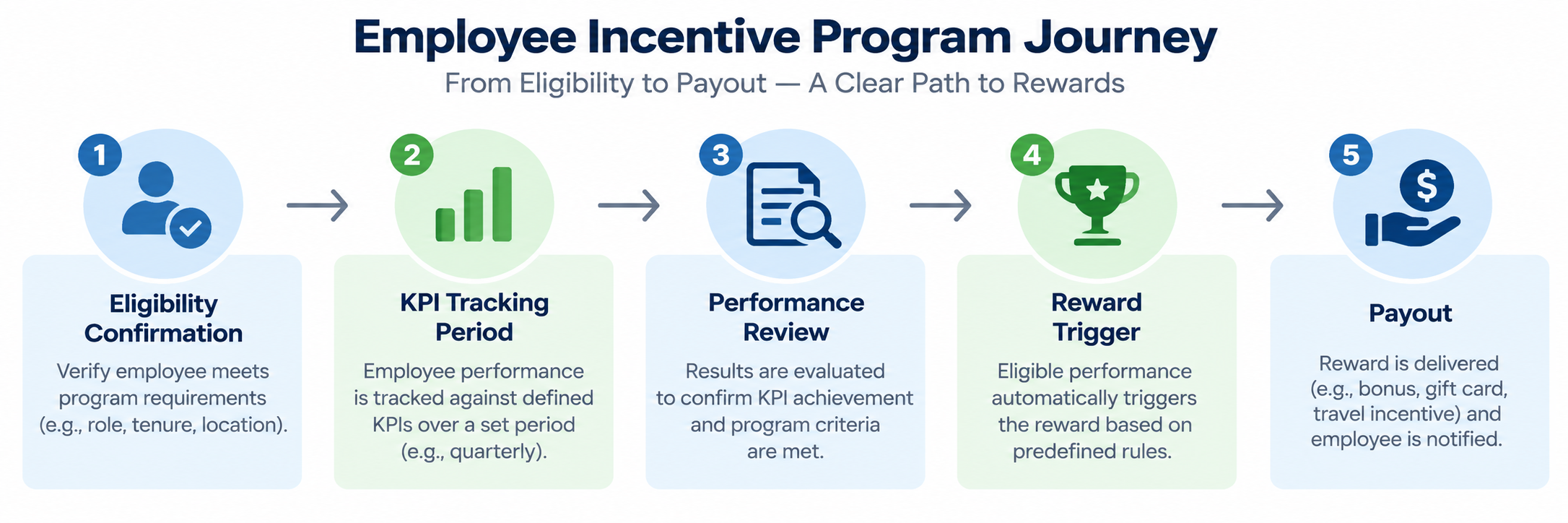
- Target participant groups: sales representatives, customer support teams, operations staff, or any combination of roles whose behavior directly influences the program’s stated objectives.
- Key performance indicators (KPIs): a clear definition of the metrics you will track, including how each metric is calculated and where the data comes from.
- Measurement periods: specific windows, whether monthly, quarterly, or annual, with defined start and end dates.
- Rules for payout triggers and clawbacks: clear guidelines on what happens if a participant leaves the organization mid-cycle or if performance data is later found to be inaccurate.
“An effective incentive program doesn’t just reward the top performers; it elevates the baseline performance of the entire team by making success achievable and transparent.”
Budgeting and Proving ROI to Leadership
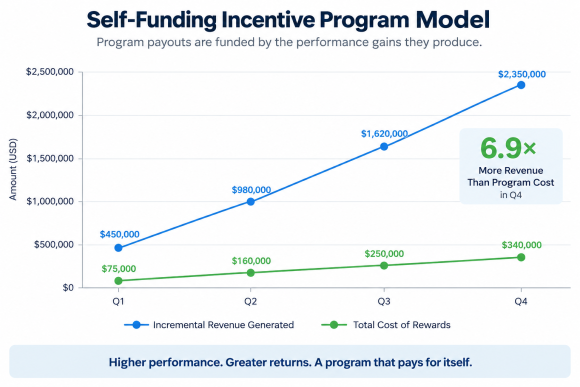
The budget section is where most proposals either win or lose the room. A CFO’s first reaction when reviewing a new program is to find the line item and ask what happens if performance does not improve. Your job is to answer that question before it’s asked by presenting a self-funding incentive model that ties every dollar of reward spend directly to the incremental revenue or cost savings the program generates.
The mechanics of a self-funding model are simple to manage. You establish a baseline, which is what the team produces without the program, and then define the incremental performance threshold above which payouts are triggered. Rewards are funded from a percentage of the value created above that threshold, which means the program only costs money when it’s working. A sales team that generates $500,000 in incremental quarterly revenue above baseline, for example, might fund a reward pool worth 8 to 12% of that figure. The organization nets the remaining 88 to 92% as pure gain. This is a win-win. That framing converts the budget conversation from “how much will this cost?” to “how much of the upside are we willing to share to capture the rest?”
To calculate ROI for the proposal, compare the total projected cost of rewards and administration against the projected incremental business gains over the same period. Include both direct gains, like revenue, units sold, or contracts closed, and indirect gains where you can quantify them, such as reduced turnover cost or faster onboarding cycles. Presenting a conservative, moderate, and optimistic scenario gives leadership a range to evaluate rather than a single number to argue with, and it signals that you’ve stress-tested your own assumptions.
Need help structuring your program’s budget? Contact Incentives Marketplace to learn how we help companies design self-funding reward structures that deliver results that matter.
Structuring Your Incentive Program Proposal Document
With your objectives, reward structure, eligibility criteria, and budget model defined, the actual document comes together more quickly than most people expect. The key is ordering the sections so that each one builds the case for the next, rather than presenting a flat list of program details. Structure drives persuasion.
A complete incentive program proposal document should include:
- Executive Summary: a one-page overview of the program’s purpose, target participants, projected ROI, and the specific business problem it addresses. This is what gets read first and often read alone, so it needs to stand on its own.
- Program Objectives: the two or three specific, measurable business goals the program is designed to move, with context on why those goals matter now.
- Target Audience and Eligibility: a clear description of who participates, how eligibility is determined, and what criteria govern entry and exit from the program.
- Reward Structure: the types of rewards offered (monetary, non-monetary, and recognition-based), the payout frequency, and how reward levels scale with performance.
- Budget and ROI Forecast: the financial model, including the self-funding mechanism, baseline assumptions, incremental gain projections, and a cost-per-outcome estimate.
- Measurement and Governance: how performance data will be collected and verified, who owns program administration, how disputes are resolved, and what the review cadence looks like for ongoing optimization.
Presenting Your Proposal to Senior Leadership
Writing a strong proposal and presenting it effectively are two different skills, and confusing them is a common mistake. The document is your evidence base. The presentation is your argument. When you walk into the room with the executive team or the CFO, the goal isn’t to walk them through every section: the goal is to make the business case clearly and quickly, then invite scrutiny.
Lead with the outcome, not the mechanism. Most leaders don’t need to understand how a points-based reward platform works before they decide whether to fund it. They need to understand what problem the program solves, what it will cost relative to what it will generate, and who owns accountability for results. Open with those three things, and save the design details for the Q&A.
Aligning your proposal with the organization’s existing objectives and key results (OKRs) is one of the most effective ways to preempt resistance. When leadership can see that your program directly supports a strategic priority they’ve already committed to, such as a revenue target, a retention goal, or a customer satisfaction benchmark, the conversation shifts from “should we do this?” to “how do we implement this well?” That alignment also gives you a governance framework for the program itself, because you’re measuring success against goals the organization has already agreed matter.
Frequently Asked Questions About Incentive Proposals
What is an incentive program proposal?
An incentive program proposal is a formal document designed to pitch a structured rewards initiative to company decision-makers. It outlines the program’s objectives, target participants, budget, reward mechanisms, and ROI measurement strategies to secure executive buy-in. The document functions as both a business case and a design blueprint: it needs to answer the financial questions a CFO will ask while also giving program administrators enough detail to execute.
How do you write a persuasive incentive proposal?
Persuasion in a proposal comes from alignment, not enthusiasm. Alignment builds trust. Focus on connecting the program directly to core business objectives, and prove financial viability before anyone asks. Clearly define your KPIs, build a self-funding budget model that shows payouts are dependent on performance gains, and demonstrate with baseline data how the program will drive measurable results. Proposals that fail usually do so because they lead with the reward experience rather than the business outcome.
What are the key components of an employee incentive plan proposal?
A complete proposal includes an executive summary, clearly defined program goals, participant eligibility criteria, reward structures covering both monetary and non-monetary options, a detailed budget with ROI projections, and a measurement and tracking methodology. Each component serves a specific audience within the approval process: the executive summary is for the C-suite, the eligibility and KPI sections are for HR and legal, and the budget model is for finance. Writing with that audience segmentation in mind makes the document more effective at every level of review.
How do you choose the right rewards for an incentive program?
Start with what you know about your target participants, including their role, their existing compensation structure, and what they’ve responded to in the past. A mix of monetary incentives like bonuses and non-monetary rewards such as travel incentives, employee gifts, or extra time off tends to outperform either category alone, because it addresses both extrinsic and intrinsic motivation. Surveys and focus groups are underused tools here; asking participants directly what they value before the program launches produces better reward design and stronger buy-in from the people the program is meant to serve. For a deeper look at what makes effective incentive programs work across different team structures, the design principles matter as much as the reward catalog.
How do you measure the success of an incentive program?
Measurement starts before the program launches, not after. Establish your baseline, which is the team’s actual performance output over the two to four quarters preceding the program, and document it formally in the proposal. Once the program is live, track your selected KPIs against that baseline at each measurement interval. At the end of the program cycle, compare the incremental revenue or productivity gains against the total cost of rewards and administration. That comparison gives you the program’s true ROI, which is the number you’ll need when you go back to leadership to request renewal or expansion.
Contact Incentives Marketplace Today
Drafting a complete proposal is the first step toward transforming your team’s performance. We help you turn appreciation into performance, and our practical solutions simplify the process from day one. Once you’ve secured leadership’s approval, the harder work begins: translating a well-written document into a program that runs cleanly, rewards fairly, and produces the results you projected. That means reliable reward sourcing, consistent performance tracking, and an administrative structure that doesn’t collapse under its own weight when the first payout cycle arrives. Partnering with an expert makes your program easy to implement, removing the guesswork so you can focus on your goals.
Ready to turn your proposal into a high-performing reality? Contact Incentives Marketplace today to discover how our flexible programs can help you drive results that matter.