
Franchise Incentive Programs: How to Reward Resellers Without Undercutting Margins
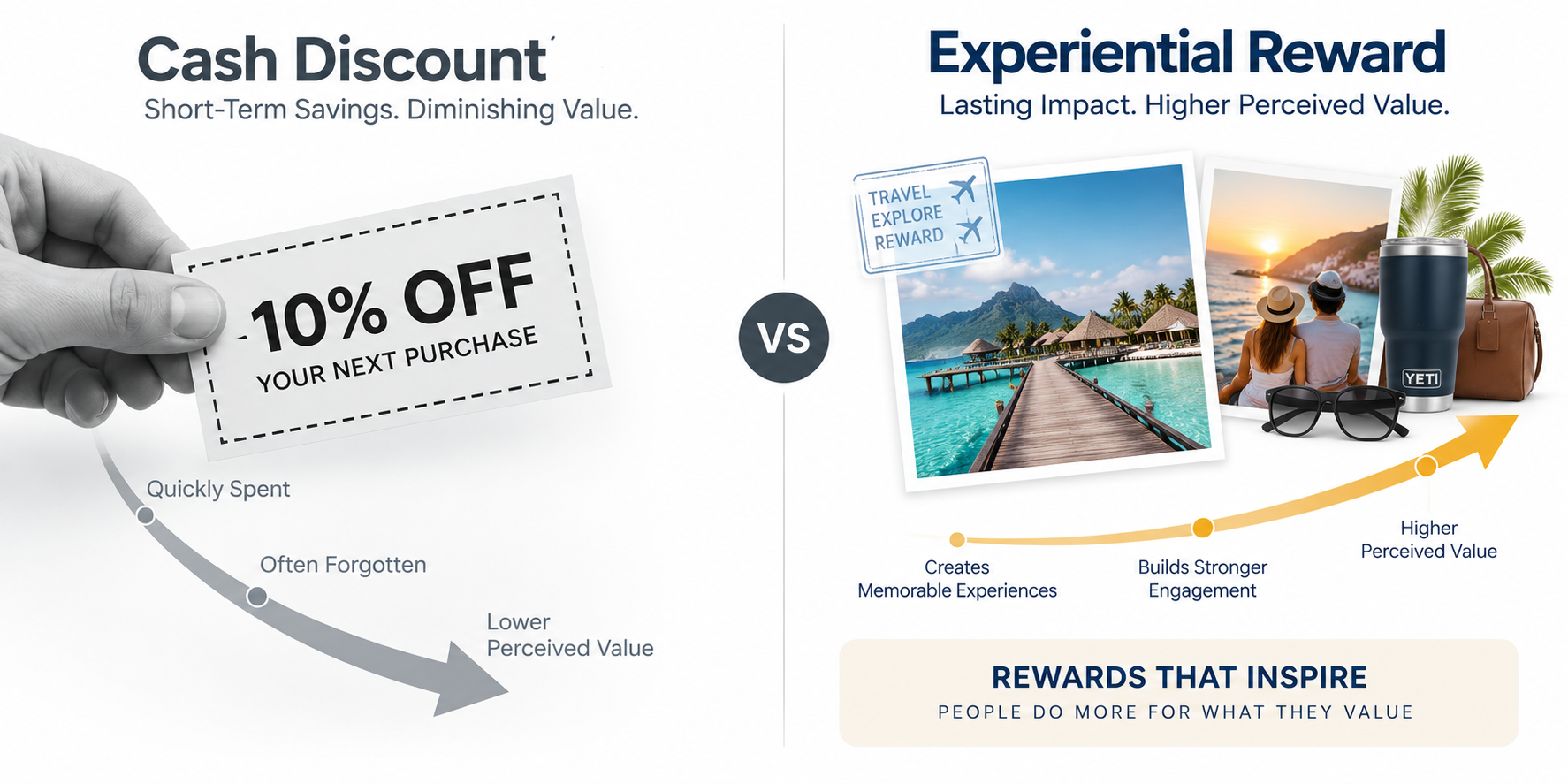
Franchise and reseller networks run on motivation, but the way most brands try to maintain that motivation quietly destroys the margins they work to protect. The default lever is discounting: drop the price, spike the volume, and repeat. This is a trap. It feels like momentum, but it trains your partners to wait for the next promotion rather than sell on value, and it conditions your end customers to expect a price that was never sustainable in the first place.
The more durable path is a structured incentive program that rewards the behaviors you want, such as certifications completed, new accounts opened, brand standards upheld, and seasonal lines pushed, without touching your price architecture. This is not a theoretical substitute: franchise networks across food service, healthcare, and specialty retail have used behavioral incentive frameworks to drive partner performance while holding their margin floors intact.
The Margin Trap: Why Discounting Resellers Backfires
Most franchise executives understand, intellectually, that discounting is a short-term fix with long-term consequences. The problem is that the short-term relief is immediate and measurable: a price reduction produces a visible sales bump, while the long-term damage accumulates quietly across quarters. By the time the erosion becomes obvious, the discount expectation is already baked into your partners’ planning cycles. Recovery is difficult.
When you rely on discounts, the negative effects compound quickly:
- Brand value erosion: Continuous discounting signals to both partners and end customers that your standard price is aspirational rather than real. Once that perception takes hold, it is extraordinarily difficult to reverse without losing volume.
- Channel conflict: When resellers compete primarily on price, they inevitably undercut each other to close deals. The resulting tension, including margin disputes, territory complaints, and partner churn, costs far more to manage than any promotional discount saves.
- Cash flow exposure: Upfront price reductions hit your margin at the point of sale, before you have confirmed whether the partner drove incremental volume or simply pulled forward demand that would have materialized anyway.
- Expectation lock-in: This turns your promotional calendar into a purchasing calendar for your partners. They delay orders, defer commitments, and stall pipeline activity until the next discount window opens.
The structural problem with discounting is that it rewards the transaction rather than the relationship. A partner who buys more because you dropped the price has not become more committed to your brand; they have become more sensitive to your price. Behavioral incentive programs invert that dynamic by tying rewards to actions that build long-term capability and loyalty rather than short-term volume spikes.
Structuring High-Impact Franchise Performance Bonus Structures
Breaking the discounting cycle requires replacing a simple, reactive mechanism, price reduction, with a structured framework that rewards specific, verifiable partner behaviors. The design of that framework matters greatly, because a poorly constructed bonus structure creates its own problems: partners game the metrics, rewards feel arbitrary, and the program loses credibility within a few quarters.
The most effective franchise performance bonus structures share a few design principles. Keep them simple. Rewards are tied to behaviors the brand can verify independently. Thresholds are set at levels that require genuine effort but remain achievable for a motivated partner. And the program communicates clearly enough that a franchisee can explain their own earning potential without consulting a manual.
- Tier-based incentive programs for franchisees: Progressive performance tiers, where rewards increase as partners hit certification milestones, quarterly growth targets, or operational compliance benchmarks, create a visible ladder that motivates sustained engagement rather than one-time bursts.
- Retroactive rebates over upfront discounts: Rewarding partners with rebates after they have hit verified volume thresholds protects your upfront margin and cash flow. The partner still earns meaningful value; you shift the timing to a point where the incremental revenue is confirmed.
- SPIFs for strategic alignment: Short-term Sales Promotion Incentive Funds are highly effective for driving specific, time-bounded behaviors, such as launching a new product line, clearing seasonal inventory, or activating dormant accounts, without permanently altering your baseline pricing. A well-designed SPIF campaign can move the needle on a specific objective in four to six weeks while leaving your standard price architecture untouched.
- Co-op marketing fund alignment: Tying marketing development funds directly to performance metrics ensures that your highest-performing partners receive the most corporate support for local lead generation, while partners who have not met baseline engagement thresholds do not receive funds they are unlikely to deploy effectively.
The International Franchise Association (IFA) provides guidance on structuring compliant incentive frameworks within franchise agreements, which is worth reviewing before finalizing any program that touches royalty structures or fee arrangements, particularly for multi-unit operators where the financial implications scale quickly.
Explore our specialized channel incentive programs and B2B loyalty programs to see how we help franchise networks reward repeat engagement and drive profitable growth. For a step-by-step planning resource, our guide on distributor incentive programs walks through how to align your network without undercutting your margins.
The Power of Non-Cash Rewards for Channel Partners
Cash discounts have a fundamental perceptual problem: they are taken immediately into operating expenses and forgotten. A franchisee who receives a retroactive cash rebate will likely apply it to accounts payable within the week. There is no lasting association with your brand, no story to tell at the next regional conference, and no emotional residue that makes them more committed to your network. The transaction closes, and the motivation resets to zero. Nothing changes.
Non-cash rewards operate differently because they create experiences and objects that partners associate with their own achievement. An incentive trip to a destination a top-performing franchisee would not have booked for themselves becomes a story they tell for years. A premium merchandise catalog that lets partners redeem points for high-end tech or lifestyle goods creates a tangible, visible symbol of their performance. These are not soft benefits: they are motivational frameworks that sustain engagement between reward events.
Research published by the Incentive Federation Inc., an authoritative body on corporate and channel incentive programs, consistently points to non-cash rewards as more effective at driving intrinsic motivation than cash equivalents. The underlying mechanism is simple. Cash is interchangeable and disappears into the budget, while a non-cash reward carries a specific identity that partners mentally label as earned recognition rather than compensation.
- Experiential rewards and travel: Top-performing franchise owners respond strongly to exclusive incentive trips or curated experiences, particularly those that feel genuinely out of reach without the achievement attached to them. The exclusivity is part of the motivational signal.
- High-end merchandise and tech: Curated redemption catalogs give partners agency over their rewards while keeping the brand association intact. Points earned through operational excellence become premium goods that reinforce the connection between performance and recognition.
- Status and recognition tiers: Public acknowledgment at annual franchise conferences, featured placement in partner portals, or a named tier designation like President’s Club or Diamond Partner uses peer prestige in ways that cash simply cannot replicate.
- Professional development and training: Access to exclusive business coaching, advanced operational training, or industry certifications rewards high-performing partners with something that directly improves their local business outcomes, which, in turn, improves yours.
Protecting Profit Margins Through Enablement-Focused Incentives
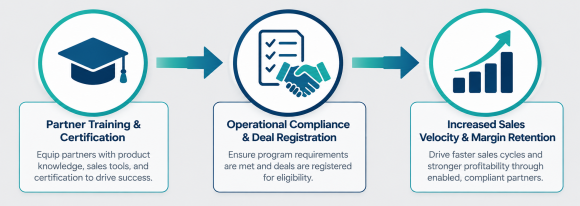
The most lasting margin protection strategy isn’t a reward program: it’s a partner capability progr
am that happens to include rewards. Focus on capability. When franchisees and resellers are genuinely equipped to sell your unique value without leaning on price, the discount conversation becomes less necessary. Enablement-focused incentives accelerate that capability development by attaching tangible rewards to the training, compliance, and deal-registration behaviors that make partners more effective.
This approach also addresses a structural inefficiency that most franchise networks carry quietly: a significant portion of the partner base is underperforming not because they lack motivation, but because they lack the tools, training, or operational clarity to perform at a higher level. Rewarding the act of closing that gap, such as completing a certification module, registering a new deal in the CRM, or passing a brand standards audit, creates a measurable pathway from current performance to target performance, with rewards serving as both incentive and acknowledgment.
Modeling the financial viability of an enablement-focused program requires careful budget planning before launch. Use our guide to calculate an incentive program budget to design a self-funding reward structure that aligns with your corporate financial goals and accounts for the incremental revenue generated by a more capable partner network. Our programs are easy to set up and simple to manage, helping you create a culture of motivation while simplifying the process.
- Rewarding training and certification completion: Points or rewards tied to product training modules ensure that franchisee staff can explain your value confidently. This reduces the frequency of price objections at the local level and protects your brand positioning in markets where you have limited direct visibility.
- Deal registration incentives: A structured deal registration program rewards partners for surfacing new opportunities early. This protects their local margins, prevents internal channel conflict between overlapping territories, and gives your corporate team visibility into pipeline health before deals are at risk.
- Operational compliance bonuses: Franchisees who consistently meet or exceed brand standards, pass operational audits, and hit customer service benchmarks represent your brand at its best. Rewarding that consistency, rather than only rewarding revenue, signals that operational excellence is a corporate priority, not just a contractual obligation.
Best Practices for Reseller Motivation and Program Design
A well-designed incentive program can fail entirely if the execution is poor. Execution is everything. Franchise networks that have invested in sophisticated reward structures often find that partner engagement drops not because the rewards are unattractive, but because the rules are opaque, the fulfillment is slow, or the communication is inconsistent. The mechanics of delivery matter as much as the mechanics of design.
Simplicity in the earning rules is non-negotiable. Partners who can’t explain how to earn their next reward tier in two sentences will disengage within the first quarter. This doesn’t mean the program has to be shallow; it means the complexity should live in the backend logic, not in the partner-facing experience. A franchisee should be able to log into a portal, see their current points balance, understand exactly what actions will move them to the next tier, and redeem a reward without submitting a support ticket.
Automation is the operational backbone that makes this possible at scale. Manual tracking, spreadsheet-based point calculations, and delayed reward fulfillment are program killers, not because partners are impatient, but because delays create doubt about whether the program is real and whether the brand is invested in it. Platforms that deliver real-time point updates and automated reward fulfillment remove that doubt entirely.
- Keep earning rules transparent and partner-facing: Every franchisee should be able to access a clear summary of the program structure, including tiers, thresholds, eligible behaviors, and reward options, without needing to contact a channel manager for clarification.
- Automate fulfillment end-to-end: Real-time point crediting and automated reward delivery eliminate the administrative drag that erodes partner trust and internal program credibility.
- Communicate progress consistently: Regular updates, such as weekly progress notifications, tier advancement alerts, and countdown messages as partners approach the next threshold, keep the program top-of-mind between major reward events.
Treat your incentive program as a collaborative investment rather than a corporate mandate. Partners who feel like the program was designed with their business needs in mind, rather than imposed on them from above, engage at meaningfully higher rates and sustain that engagement across program cycles.
Measuring the ROI of Incentive Programs
Treating an incentive program as an expense rather than an investment is the single fastest way to get it cut in the next budget cycle. The programs that survive, and get expanded, are the ones that generate a clear, justifiable return on investment measured against metrics that the finance team recognizes as meaningful. That requires deciding, before the program launches, which KPIs will define success and how they’ll be tracked.
The most useful program ROI metrics fall into two categories: partner behavior metrics and revenue impact metrics. On the behavior side, you want to track partner activation rate (the percentage of eligible partners who engage with the program), reward redemption rate, training completion rates, and deal registration volume. These metrics tell you whether the program is reaching the partner base and whether partners are taking the actions you designed it to drive. Low activation is almost always a communication problem; low redemption is almost always a rules complexity problem.
Revenue impact metrics are where the business case gets made. Numbers do not lie. Incremental revenue per activated partner, compared against a control group of non-participating partners or against the same partners’ pre-program performance, is the clearest signal of whether the program is generating returns above its cost. Tracking average order value, new account acquisition rates, and seasonal sell-through rates among program participants versus non-participants gives you the data to demonstrate that motivated partners genuinely outperform unmotivated ones, and by how much.
There’s a case to be made that the most important metric is program cost as a percentage of incremental revenue generated. A well-designed program should be largely self-funding: the additional margin captured from higher partner performance should cover the cost of the rewards, the platform, and the administration, with meaningful surplus left over. If that ratio is inverted. If you are spending more on rewards than the program is generating in incremental revenue, the issue is almost always in the threshold-setting or the behavior targeting, not in the reward value itself. Adjusting the qualifying behaviors and the tier thresholds is usually more effective than cutting the reward budget.
One metric that’s consistently overlooked is partner retention rate. The cost of losing a trained, certified, high-performing franchisee, and replacing them with someone who needs 12 to 18 months to reach equivalent productivity, far exceeds the annual cost of a well-funded incentive program. When you model program ROI, that retention value belongs in the calculation.
Frequently Asked Questions About Franchise Incentive Programs
What is the most profitable franchise to get into?
Profitability varies considerably by industry, but franchises in food service, healthcare, and specialized cleaning services tend to generate the highest returns on investment. The factors that drive long-term profitability, including brand recognition, operational support infrastructure, and manageable startup costs, matter more than the industry category itself. Regardless of sector, implementing structured franchise incentive programs is critical to helping local owners protect their operating margins by rewarding the behaviors that drive efficiency and revenue growth, rather than relying on price reductions that compress their already-tight unit economics.
What are examples of incentive programs?
Franchise incentive programs take several forms depending on the network’s goals. Common structures include reduced franchise fees for military veterans, multi-unit development discounts for operators who commit to expanding their footprint, performance-based royalty rebates that reward franchisees who hit quarterly growth targets, and financing assistance through third-party lender partnerships that lower the capital barrier for new operators. Beyond financial structures, brands use non-cash rewards, training completion incentives, and co-op marketing funds tied to performance metrics to drive specific operational behaviors across the network.
What franchise can I start with $10,000?
Few major franchises have a total startup cost at or near $10,000, but home-based service franchises, such as commercial cleaning, pet sitting, mobile notary, and consulting services, often have low overhead and franchise fees that fall within or near that range, provided you already own the necessary equipment. These low-overhead models depend heavily on local marketing execution and partner enablement to generate growth, which makes a well-designed incentive program particularly valuable for motivating franchisees who are operating without the brand visibility that a physical storefront provides.
What business has a 90% success rate?
No business category carries a guaranteed success rate, but established franchises consistently report higher survival rates than independent startups, largely because they enter the market with proven systems, established supply chains, and consumer demand that’s already been validated at scale. Industries like tax preparation, senior care, and fast-casual dining tend to show strong long-term survival rates for these reasons. Aligning those proven systems with effective channel partner incentive strategies, rewarding franchisees for operational excellence and customer retention rather than just revenue volume, further reinforces the structural advantages that make franchising more durable than independent business ownership.
Reach Out to Incentives Marketplace Today
Designing a franchise incentive program that rewards your network without eroding your margins is a strategic necessity for any franchise system that wants to grow sustainably. Moving away from transactional discounting toward behavioral, non-cash, and enablement-focused rewards protects your brand equity, builds genuine partner loyalty, and generates the kind of incremental performance data that makes the business case for continued investment. At Incentives Marketplace, we remove the guesswork from incentive planning. We help you turn appreciation into performance with flexible programs designed to align with your business goals.
Your goals. Our expertise. Results that matter.
Ready to transform your reseller network? Explore our franchise incentive programs to discover how you can drive performance, protect your margins, and achieve results that compound over time.